
|
Quote:
Watch this video and see if it clears up a few things for you. http://www.lynnblakegolf.com/gallery...hereAreYou.wmv |
Bagger - thanks for referring me to that video. I enjoyed it. However, it still doesn't help me understand the difference between loading in swinging versus hitting. I can understand why Yoda states that the swinger loads against the top of the shaft with his PP3 when he eventually gets to the end position. However, what happens if a swinger decides to limit his backstroke to the top position (hands opposite the right shoulder like a hitter) because he cannot get a full shoulder turn. Then his PP3 position could be said to be behind the shaft - like a hitter. In that situation, I cannot understand the difference between a swinger (who has limited his backstroke to the top position and doesn't get to the end position) and hitter. It would seem to me that the PP3 point (established when gripping the club at address) aways contacts the shaft at the same point in a swinger, but it is called "under" the shaft or "behind" the shaft depending on where the clubshaft is located in space. However, a different semantic label doesn't necessarily imply different biomechanical loading actions in a swinger versus hitter - or does it?
Jeff. |
Lots of good questions Jeff.
We'll take them in bite size chunks. First difference; a swinger loads pressure point 3 with a quarter turn roll of the sweetspot at the top. 10-11-0-3 Remember, with Swinging, Pressure Point #3 must have a Feel of being rotated a quarter turn at The Top with Standard Wrist Action (10-18-A), just and only because of Loading Action direction- no actual movement of anything. So from The Top to Release, the Loading put the top side of the Clubshaft against the first knuckle of the forefinger. But with Hitting there must be NO change whatever. When the Wrists "Swivel" back to the Vertical Position (4-C-3) during Standard Wrist Action (10-18-A) per 6-B-3. Pressure Point #3 may -but need not- return to its "strong" position (Aft side of the Clubshaft). That is - if left in "Top-of-the-Clubshaft" position it becomes a Weak Single Action Grip (10-2-A) and the interchangeable equivalent to 10-2-C for Swingers. But both are improper for Hitters using Single Wrist Action (10-18-C). |
Bagger
I cannot understand your posted answer. How can the PP3 point be rotated another 1/4 turn if the backstroke is limited to below shoulder height and doesn't get beyond shoulder height (and doesn't get to the end position where the top of the shaft [which is now parallel to the ground] rests on the PP3 point)? Surely, if the backstroke is limited to a 3/4 swing, then the PP3 point is always behind (aft) of the clubshaft because that was where its position was at address setup? A golfer, who has a limited backstroke action, is not moving his PP3 point from its aft position during the swing. I definitely cannot understand paragraph 2, which seemingly implies that if a golfer adopts a strong single action grip at address (10-2-B), that PP3 will not necessarily end up aft of the club at impact when the wrists swivel back to the vertical position (per 4-C-3) using standard wrist action (10-18-A). It seems to imply that PP3 can remain/become on top of the club. How is that possible in a swinger's 3/4 action as described above - when the PP3 point is never against the top of the shaft when using a standard strong single action grip and a limited backstroke action? Jeff. |
A swinger using horizontal hinging will have rotated the clubface a quarter turn by the time the parallel to the ground position of the clubshaft is reached -from there there is no more rotation -it is purely "back and up" .
So with a "top" rather than "end", backswing, you've still "rotated" a 1/4 turn. From there it is all just Rotation- ON PLANE.:golf: |
Quote:
So take your hands to Top . . . arms in line with your shoulders. Now change the position of your right forearm. Notice with swinging the forearm will be more under and the club lays down more and thus the load is on your knuckle. Now change your forearm to supporting the LEFT ARM and club. Notice how the pressure is more aft of the club and on the "fleshy pad" And the clubhead goes "HIGH." Homer said that the hitter has a "high" clubhead as a result of the loading. |
Loading
A swinger loads the left wrist.
A Hitter loads the right elbow. For a swinger, it makes no difference whether its a chip, pitch, 3/4 swing or full swing. When the left wrist is loaded, there can be a 1/4 turn loading on the right index finger knuckle. No movement of anything, just a shift in the loading as the clubhead reaches the end of its arc. Ask John Riegger about how effective this is for Bunker Shots. Along these lines, the right elbow is in a pitch position for swinging vs a punch position for hitting to accomodate the drag (via the number 4 accumulator) or drive (via the #1 accumulator) of the clubshaft and the associated amount of right wrist bend. |
Neil and 12 piece bucket - thanks for your input.
Unfortunately, I still cannot grasp the difference. Neil - you state that one institutes a 1/4 turn of the clubface by the end-takeaway and after that there is only rotation. How does one turn the clubface 1/4 turn if not by rotation? What is the difference in rotary technique employed in turning the clubface 1/4 turn during the start-up swivel versus the technique of rotation of the left arm/forearm that occurs throughout the remainder of the backstroke? I can understand the idea of a start-up swivel, but are you asserting that the total amount of left arm/forearm rotation is different in swingers versus hitters if both stop their backstroke at the 10:30 o'clock position. Does that cause their clubshaft to lie at a different angle at the 10:30 o'clock end-backswing position, and can you definitively know if a golfer is a swinger versus a hitter by simply looking at their clubshaft angle when the left arm gets to the 10:30 o'clock position? 12 piece bucket I know that HK states that the right forearm supports the primary lever assembly in hitters and only the clubshaft in swingers, but I cannot clearly envisage the difference because I think that the left arm and clubshaft are essentially in the same plane during the late backstroke when the hands are reaching shoulder height (as the left arm flying wedge), and that if the right forearm is held at right angles to the primary lever assembly it is also at right angles to the clubshaft. Am I wrong? Consider the following photo sequence of Stuart Appleby's backswing. 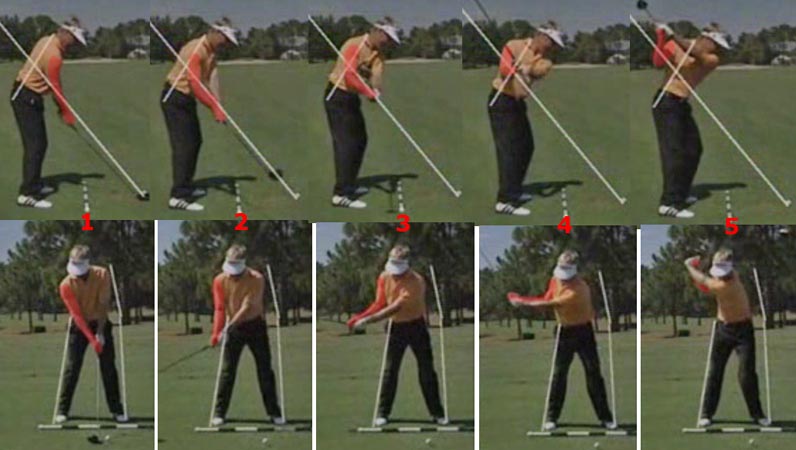 Note that he doesnt get his clubshaft to parallel to the ball-target line at the end of his backswing because he stops his backswing earlier than the end position. At the top of his backswing his right forearm is held roughly perpendicularly to both his left arm and clubshaft because they are on the same inclined plane. Can you definitively state that Stuart Appleby is a swinger or a hitter based on his right forearm alignments? Neil - does Stuart Appleby have a 1/4 turn start-up swivel, or not? Here is another photograph of a golfer who has a shortened backswing - Aaron Baddeley. 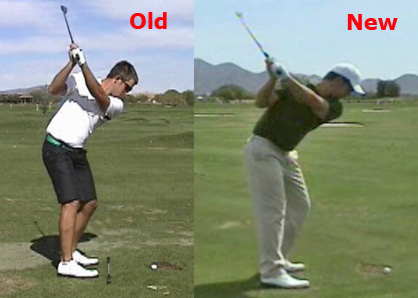 The left photo is his old swing and the right photo is his new Bennett/Plummer-taught swing. His left arm is lower/flatter in his new swing, but in both his new/old swing his left arm and clubshaft are in the same plane at the top of his backstroke so the right forearm is in opposition to both the left arm and clubshaft (similar to Stuart Appleby's situation). Can you definitively tell if Badds is a hitter or swinger based on these forearm alignments? Jeff. |
Quote:
Bagger - I have seen those statements previously. I can understand the concept of loading the right elbow if one simply stops the backswing when the right elbow stops folding. However, if a swinger stops his backswing at that same time-point in the backstroke, is he also not loading the right elbow? Also, if a hitter gets a 90 degree angle between the left arm and clubshaft at the end of his 10:30 o'clock backstroke, and a swinger gets a 90 degree angle between his left arm and clubshaft at the end of his 10:30 o'clock backstroke, then in what sense are they loading the left wrist differently? You also seem to be implying that a swinger makes that 1/4 turn loading of the right index finger at the end of the backstroke. Hmm! That is very different to Neil's suggestion that the 1/4 turn occurs during the start-up. Does that 1/4 turn involve a hand rotation, and does that hand rotation occur due to forearm rotary movements or rotary movements at the left shoulder socket level? Jeff. |
I was editing my post above when you posted. Don't confuse visible plane angles with hitting or swinging. Its very difficult to see the differences visually in shorter backstrokes. Elbow position through release is one clue and finish swivel is another.
The quarter-turn doesn't have anything to do with the startup swivel and the swinger doesn't "make" it happen. Again, there is no effort in "moving" anything. The visual clues might make a good thread. |
| All times are GMT -4. The time now is 08:27 AM. |