
|
Quote:
As I pointed out originally, I don't really "need" it, because I can already keep the clubhead below my hands. |
Ho Ho Ho!
Quote:
|
Quote:
Thanks man! Bucket |
Quote:
|
Curing The Real Problem(s)
Quote:
Quote:
Instead, the problem is an exaggerated Axis Tilt during the Start Down and Downstroke. He achieves this over-tilting of his spine (back and away from the Ball) by dropping his Right Shoulder severely Under Plane. This misalignment, in turn, is achieved by allowing his Head to drop back and down -- he Sways and he Bobs. The result is obvious: He continually hits 'up' on the Ball -- Scooping -- all the while doing a yeoman's job of maintaining a Flat Left Wrist. In fact, he apparently has absolutely no sense of the correct Three-Dimensional Impact Geometry (Down, Out and Forward), much less how to achieve it. Thus, the cure is not more work on the Flat Left Wrist, but on teaching him (1) how the Body Pivot works in the correct Start Down; (2) how his Head should be positioned at Address; and (3) how to maintain that Head Position from Address to the end of the Follow-Through (Both Arms Straight position). In other words, this student has Pivot and Stationary Head problems (Zone #1), not a Flat Left Wrist problem (Zones #2 and #3), and they must be treated accordingly. |
Mia?
Quote:
Nobody on our end deleted it. Takes a lot to get Sheriff Bagger riled up and I usually send a PM if something needs to be addressed in a post. As long as things don't get personal, all is good. I've said it before, we value your contributions and in some cases, it helps bring out the best in us. |
Quote:
You are precisely on point as always. I went back an reviewed. That guy had a very perverted idea of axis tilt. It was even present at address. Then from the top his left shoulder shot straight up in the air. With that pivot he had no chance of achieving any DOWNARD dimension. Even though his left wrist was flat. Zone 2 and Zone 3 can only be as good as Zone 1. Very nice analysis. It's like EC says, "Just stand there and take it up with the Right Forearm." Thanks! Bucket |
Yoda doesn't need my help...
Quote:
Long story short...it can be done. |
Thank you
Quote:
|
A wonderful series Lynn - great stuff!
hinge action with an open hand hinge action with a fist A classic! - EdZ |
Porch Light Stuff
Quote:
|
The REAL Problem
Quote:
Also notice that in tape #3, Ben physically moves him through this "perverted tilt" which you mentioned, telling him to tilt until the left elbow is past the row of balls. |
More Black Magic
Quote:
|
Quote:
Bagger P.S. I'm moving the Doyle discussion to the appropriate thread. |
Yoda,
Ignore Joe's unappreciation and rudeness. After all this is YOUR site and you can do as you wish. The rest of us truely appreciate your and Baggers efforts. I, as a low handicapper like to see changes being made from someone in my handicap range. Many of us suffer from the same problems. ie..getting stuck. Sitting there watching a hacker getting frustrated and not listening isn't as useful to me as this series was. On to my question. What did you change in his setup? I see where it's been mentioned that changes in his setup cured other problems. What were they and what did you change? Thanks. |
The Beginning Of Right Forearm Magic
Quote:
|
Lag pressure direction
Yoda, in the video, you talk about directing the lag pressure down with the #3 pressure point. This may be beating a dead horse, but how does the swinger do this with that the right hand only like you were demonstrating? Or should the swinger practice that with only their right hand?
|
Yoda,
Is that why you have him approach the shot with the right arm flying wedge? so it gets on plane at address? thanks |
Right Arm Practice For Swingers
Quote:
I absolutely endorse practicing that move with the Right Arm only, first without a Club and then with one. At the Top, mentally draw a straight line from the #3 Pressure Point to the inside-aft quadrant of the Ball. Then, as your Downstroke Pivot Loads the Lag in Start Down, feel as though your Right Hand remains at the Top of the Stroke. Finally, with your Right Hip Cleared and the Lag Loaded, direct your Thrust directly down that Line and through your Aiming Point (usually the Ball). Once you've got the move down pat, practice with both Hands. |
Yes Yoda, I remember this well. You and Luke performed this movement together with your right arm. It is right up there with the "Hitters" handshake............
Quote:
|
Thank you Yoda & Co for a great video
Seeing and hearing you applying the TGM stuff in context vas very valuable.
It's one of the best golf instruction video I've ever seen. For me personally it may even be the most valuable one. I think this video series could serve as a good program for trimming the stroke before next season - for swingers. Watching chapter 1, take it to the range, rewatch ch 1, evaluate, watch ch 2, do second range session with ch1 repetition and then ch2 main part. Etc. 3-4 times a week in 3-4 weeks, and the swing should be back in great shape - and executed by an uncluttered mind. Thanks to all on the LBG team for bringing this out to us. |
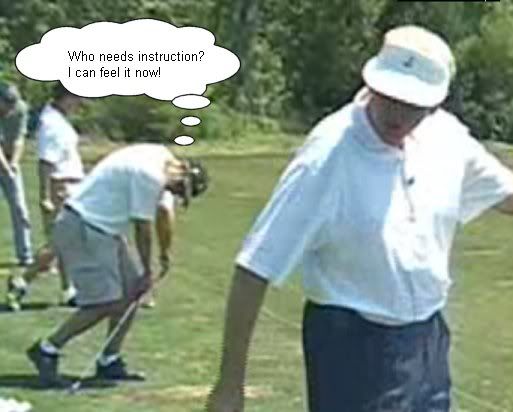
Thanks for putting up another great video. I have watched them a few times. I've watched #1 more times and the guy listening intensely in the background caught my eye. I have no idea what he is thinking - might this be it? :)
 |
Ummm....
Can someone help me out?!!?!? How do I see the vid? Thanks! |
Quote:
http://www.lynnblakegolf.com/forum/v...se_images&g=24 |
Thanks Metallion!!!!
|
Metallion....Look at that guys lag. Flat left wrist and bent right. He could turn an 8 iron into a 3 with that forward lean. :)
|
Quote:
He (the bystander) is actually not trying to hit a ball. He - for some reason - does that move after missing a ball completely. It is not his swing. Seems he is listening to what Lynn sais and tries to make something of it. Maybe he heard Lynn say "forward leaning shaft" earlier on. :D |
Quote:
DRW |
Achieving Axis Tilt
Quote:
My post you quoted above was in reference to the Ben Doyle Lesson now in our Gallery, not Collin Neeman. I am not planning a release of more of Collin's lesson. However, we will post another of Ben's in the near future. Regarding the required Axis Tilt, it is accomplished by the Hip Slide while maintaining a Stationary Head. This Hip Motion causes the Right Shoulder to remain On Plane during the Downstroke (from the Top through the end of the Follow-Through). |
Have just finished watching this series of clips (while home fighting an upper respiratory infection). What a treasure!! My sincerest thanks to all involved!
|
lol someone watch chapter 1....go to 4:34....
The things golfers do....lol. Cracked me up. Listening in on that lesson helped him real good eh? ;) |
Quote:
Thats one exagerated impact fix position right there:D |
Many thanks to the team that put the video together. For those of us ho have no chance of a lesson with Yoda this is a real bonus and truly appreciated.
|
In Homer’s introduction to TGM he states:
“The more rudimentary a player's skill, the less difference the "differences" make and the more difference the "samenesses" make. The more precise a player's skill becomes, the more this is reversed.” Therefore, when MizunoJoe said “It would be much more instructive to see Yoda take the student in Ben's lesson and make him look like Collin.” he was simply saying, in effect, that he would prefer to see a video that demonstrates the "samenesses" of the golf swing as expounded in the chapters on “Basics” namely 2,7,8,9 & 14. Doesn’t this idea have merit and wouldn’t it make an interesting theme for another video? |
The Sounds Of Silence
Quote:
The video was shot the weekend before MJ wrote his post and was never intended for the site. Nevertheless, it meets head-on the issue of Effective Stroke Training in the earliest stages of learning Golf. You will be forced to look, Look, LOOK because, unknown to me, the battery on my external microphone had died. Frankly, I view that circumstance as providential, because your attention will not be diverted by 'words' from the visual and kinestethic process used to effect the learning. Vickie first learns to keep her Left Wrist Flat while swinging without a ball. As you will see, that discipline immediately vanishes when she is confronted with the task of actually hitting the ball! As the lesson progressess, she gradually gains the ability to make the correct motion and hit the ball at the same time. Near the conclusion of our time together, Vickie was hitting little pitch shots with a truly sound Golf Stroke. All was not 'perfect', of course: Like a newborn colt, her Motion was still a bit wobbly, but its character was in place. And though you are unable to hear it, many of her Strokes actually resulted in the sound of pure Compression. A sound, I might add, produced in one hour that has yet to be achieved in the lifetime of the majority who play the Game. |
Yoda, can't wait for those vids! Want to see the basic motion curriculum in action!
|
thats a beat set of video's! thanks muchly to everyone involved. I've been inspired to dedicate more time to basic and aquired motion training, and that cant hurt!
|
Great Video
Thank you Lynn and Collin for the video. Much appreciated. I've read parts of TGM in the past, and have just started revisiting it after finding this website.
I think Collin has a very powerful swing and obviously he has a very good hand-eye coordination. However, I do see a fundamental fault that I personally have problems with as well. I was wondering whether it had been addressed during the lesson. The fault I'm talking about is his head movement. He tends to "lunge" his upper body at the ball and thus he loses his posture during the swing. In effect, he is falling forward and losing his balance during transition and downswing. His athletic ability allows him to recover, but his accuracy probably suffers due to this excess head movement. In chapter 6, if you watch his iron swing around 1:09 into the video, you can monitor his head movement. Pause as he starts his takeaway and note his head position. Now pause again around halfway down position. His head has moved DOWN and also FORWARD towards the ball. If we could see a video from the front view, we'd probably see the head move a little in the direction of the target as well as he starts the downswing. Collin's excess head movement can be seen in his chip shots and pitch shots as well. If you go back to chapter 1 around 0:47 into the video, you can see Collin performing a "punch shot with a swivel". Note his head movement during the swing. His head moves DOWN and also TARGETWARD during transition and downswing. This head movement causes him to have a "hunched over" look at followthrough and finish. Continue to watch as Lynn takes the club from the student and demonstrate. Watch Lynn's head. It stays beautifully still from address through impact to followthrough. You can see the contrast in the finish positions. Collin has the "hunched over" look at the finish where his head is the closest to the target. Lynn has the classic "reverse K" look where his left hip is the closest to the target. Please understand that I'm not trying to criticize Collin's swing or Lynn's teachings. However, I do have a similar problem and find it very difficult to fix. I would love to hear Lynn's views on this and how it might be fixed. Is it matter of working on chip shots and pitch shots with a stationary head, gradually working up to the full swing? BTW, any future plans to hold clinics/seminars in Australia? I live in Sydney and would definitely attend if Lynn came out here. |
yeah i do move my head a lot i am trying to stop i have always had a problem with it hoeckey messed my swing up a lil now i am done though so that should help
|
Collin, I think you've got a powerful, athletic swing. The only reason I mentioned your head movement is that I'm having the same problem with my swing. I was hoping Lynn might jump in with some suggestions on how to approach this problem.
Was the head movement discussed during your lesson with Lynn? If so, how are you guys approaching this problem? Thanks. |
| All times are GMT -4. The time now is 06:17 PM. |