
|
Why Zero #3 Accumulator In The Basic Motion?
Quote:
With the Club located normally under the heel of the Left Hand, any Turn and Roll of the Left Wrist causes the Clubhead to 'travel' as it seeks to maintain its In Line condition with the Left Arm. This is not Lever Extension (the shortening and lengthening of the Swing Radius via the Left Wristcock). Instead, it is Rhythm -- the true Overtaking Action (of the Hands by the Club) during the Release Interval ('Through the Ball'). Conversely, when the Club is gripped in the cup of the Left Hand (or, alternatively, when the Left Wrist is fully Uncocked), any Turn and Roll of the Left Wrist actuates only the Clubface (and not the Clubhead). Thus, the Overtaking Action with its Clubhead travel and Rotational Power (4-C) is eliminated (6-B-3-A). And this, by Basic Motion definition, is our objective in a One Accumulator Stroke that uses either the Left Arm or the Right as the sole Power Source. Also, the Basic Motion of 12-5-1 introduces Hand Motion (Items #20 and #21), i.e., the Hinge Action (Clubface Control) and its Rhythm (Left Arm and Clubshaft remaining In Line). With Zero #3 Accumulator, all three Hinge Actions have identical Clubhead travel distances to the end of the Follow-Through (Both Arms Straight position) and hence, identical Rhythms. This allows the player to focus only on the Left Wrist alignment necessary to produce the desired Clubface Motion without concern for Clubhead travel differences. So, to limit Clubhead Power and to simplify Clubface Control, Accumulator #3 is eliminated in the Basic Motion. |
Foot Loading At Address
Quote:
"...an even distribution between both Feet but with enough on the heels to allow the toes to be lifted up momentarily without altering the distribution between the toe and heel." This loading is in stark contrast to the Foot loading recommended by the Golf Digest folk back in the '70s and '80s: Enough weight on the balls of the Feet to allow you to tap your heels! |
Actuating The #2 Accumulator
Quote:
Regarding a "'max' #2 Accumulator," the Wrist is considered to be in a Cocked condition any time it moves beyond the Level (a straight line is formed from the wrist bone to the edge of the hand) to its maximum Cocked condition. It matters little how much that Wristcock varies from player to player. What is important is that if the Wrist is Cocked, it should be fully Cocked. This eliminates the 'wobble' inherent in the less-than-full condition. Regarding Hogan's Wristcock, remember, the Wrist Cock is a Perpendicular Motion. It is not Wrist Bend, a Horizontal Motion. When the Grip is taken with the Left Hand Turned, the amount of Left Wrist Turn properly becomes Left Wrist Bend at the Top (4-D-1). This is a Double Wrist Cock (10-18-B), and it is restricted to true Swingers (those who depend solely upon Centrifugal Force to align both Clubface and Clubshaft). Ben Hogan employed this Turned Left Hand and Double Wristcock procedure in his early days, and it is readily seen in the sequence photographs of his first book, Power Golf. Later, in an effort to combat his tendency to Hook, he made two significant changes to his Grip: First, he moved the Left Hand from Turned to Vertical. Normally, this Grip produces a Single Action -- Wristcock Only. However, Hogan added a Wrist Bend at the Top thinking that he could now Roll his Wrists through Impact as hard as he wanted, and the Ball still would not Hook. Warning: This is the Land of the Meateaters, and only The Brave and Supremely Talented dare enter. |
Quote:
I was trying to figure out how Acc. #4 was involved in a stage one stroke. Then I referred to 6-B-4-0 and read this; "Left Arm Power in any form or amount can still be considered #4 Accumulator Action." So, yes Accumulator #4 is involved in the two barrel stage 1 motion. I learned something today, now back to answering the pro shop phone. Soting through the Duffer's Bible. B-Ray |
Quote:
|
The Basic Motion -- Always A One Accumulator Stroke
Quote:
Both Accumulators are referenced in 12-5-1 because both Arms are in Motion -- one Active and the other Passive. And that Motion is identical, no matter which Arm actually drives the Stroke. |
Quote:
For example, when using 12-5-2, we introduce Accumulator #2. Can you imagine this amount of Wrist Cock for a basic pitch shot? 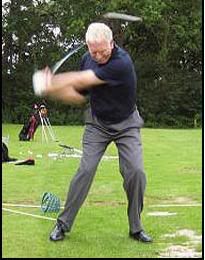 |
Power Regulation Versus Wrist Action
Quote:
Do not confuse the speed and sharpness of the above Maximum Power Loading Action (7-22) Driver Stroke with the Maximum Cocked Wrist (4-B-2) of the Pitch Shot. Also, remember that the Driver is the longest Club in the bag and accordingly has the Flattest Plane. The Pitch Shot, on the other hand, normally is played with the Sand Wedge, the shortest Club (except for the Putter) and is swung on a Steeper Plane. These facts, plus a slow shutterspeed, enhance the illusion of a 'greater than normal' Cocked Left Wrist. Actually, the degree of Wristcock afforded by the Flat Left Wrist (Accumulator Lag / 6-C-0) is not all that great to begin with. And as I've stated, it is advisable to have maximum Wristcock when that Accumulator is employed in order to eliminate Power Package Wobble. Maximum Wristcock does not mean maximum Accumulator #2 Power! It is true that varying the amount of 'Out-of-Line' will increase or decrease the amount of Power that ultimately can be Released (6-B-0). However, that does not mean that a full Wrist Cock demands full Power. To the contrary, Clubhead Power is a function of Effective Clubhead Mass and Clubhead Speed per 2-M-2. And this Power Regulation is totally under the conscious control of the player. I might add that I play many of my Pitch Shots with the Left Wrist Level, especially when Hitting. Remember, 'daintiness is dangerous' and the shorter Stroke with its stronger Thrust has definite advantages (3-F-6, 6-C-2-D and 10-19-A). |
One Error And More
Quote:
|
Quote:
Moving on... Does 12-5-2/3 include all the components before it (e.g. components in 12-5-3 includes all those in 12-5-2 and 12-5-1)? The 1-L reference for 12-5-1 #15 (Pressure Point #3) is 1-L-7 and 1-L-12. 1-L-7: The Lever Assembly is driven by exerting pressure against it. So for obvious reasons, I'm thinking this reference is for Hitters only. Hmmm... 1-L-12: Ball Speed is dependent on both before Impact and after Impact Clubhead Speed. I'm thinking...PP#3 is usually assigned for sensing Clubhead Lag. And the prestressed shaft that comes with Clubhead Lag helps resist Impact Deceleration. Hmmm... |
| All times are GMT -4. The time now is 03:14 AM. |