|
The Real Clubhead Lag!
People say Sergio has lots of Lag. That's Accumulator #2 Lag they are usually referring to. The angle between left arm and clubshaft is what they see.
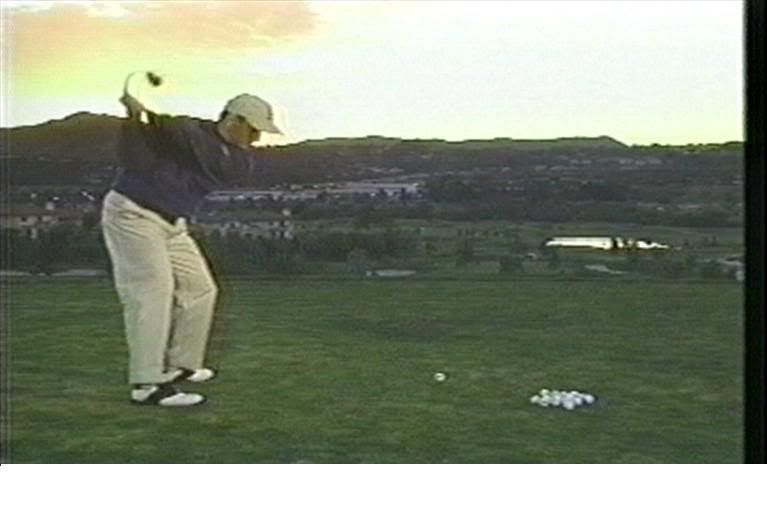
But TGMers know that Clubhead Lag is the resistance of the Sweetspot to change direction, which is established during Start Down. It is very slight, very ellusive and hard to see. But it's not hard to see in this case! 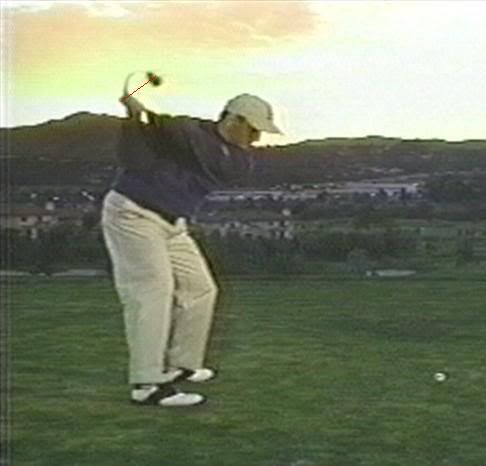 Now THAT'S Clubhead Lag! You may say he's using some women's whippy shaft. Uhh....no. It's XXX :cool: |
Loadin' the Shaft...
Quote:
Per 6-C-2-A "The Clubshaft is stressed by the weight of the Clubhead resisting a change in its direction or velocity - which is Acceleration....Change of direction bends it during Longitudinal Acceleration (10-19-C)..." Per 6-C-2-C "The prestressed Clubshaft will resist the added weight of the ball during Impact..." 1/16 inch of bend adds 1 ounce of mass. Per 2-M-1 "Power is the total effective force impinged on the ball." Per 2-C-0 "The Ball leaves the Clubface with force proportional to the compression produced by Impact." Power is 1/2 x Mass x Velocity squared. When you load the shaft, mass is added. When mass is increased, power is increased. When power is increased, the "total effective force impinged on the ball" increases, the FURTHER the ball flies if all things remain the same. |
Same here
That dam tape is the same reason i got hooked on TGM also. Some times its a curse but I know its the truth though after hearing Bobby's impact. One day I will have that sound](*,)
|
I can verify that Schaeffer's shafts are xxx in that picture. Bobby can also hit lots of different shots including soft pitches, punches and partial speed shots.
He really should have made the tour. Gregg was just as good as a young man and even now. Lucky for us students that they became teachers. We'll be in Australia for our golf schools starting this weekend. |
Quote:
The definition of 'on plane force' and 'loading and supporting at 90 degrees'. |
Clubshaft lag
So what use is clubshaft lag like this (by the way I think the magnitude of the bend "observed" here is a aperture speed issue) if the shaft is bent toe up? Does anyone think this is useful in transfering power to the ball? If so how?
Golfie |
Transferring Power
Quote:
By loading the shaft, you "prestress" it, making it less susceptible to deceleration during impact. Why is that needful? Because ball speed is dependent on two factors; Clubhead approach speed and Clubhead separation speed. The more loaded the shaft, the more it resists deceleration because of a greater Moment of Inertia, hence increasing the second contributing factor to ball speed - separation speed. With high approach speed and high separation speed, we will get high ball speed ceteris paribus which translates into "big" shots! Hope that helped. |
Some more lag
Quote:
The saft is stressed at the top and the player (not me , alas...) keep this stress till impact Is it usefull: YES How: by adding this "stocked energy" during impact. Read Compda... PM  |
Direction of Clubshaft bend
Compda,
Thank you for the by the book answer. Please take a harder look at the diection of the supposed bend in this shaft and tell me if you think this will increase clubspeed. The shaft is bent so that it is toe up, is it not? Golfie |
Nice pics
Quote:
How did you get the frame by frame? Screen shots? The bend you see here is shutter speed issue. You would not see anywhere near this bend with high speed photography. Has anyone visited a ShaftLab equipped facility? If so has anyone recorded a driver swing that had a lagging clubshaft prior to impact and a clubhead speed greater than 110 mph? My local guy at the Golftown mega store says he has not seen one. Mind you they've only had the gear for 6 months. Golfie |
In a nutshell
Guys,
I don't want anyone to feel bad they don't observe the same degree of bend that Bobby "demonstrates" here. You too can have it if you can find a camera with a 100th of a second shutter speed. It would probably be detrimental to your game if you tried (with a better camera) Golfie |
Quote:
Example: similar shutter speeds...slightly blurry hands 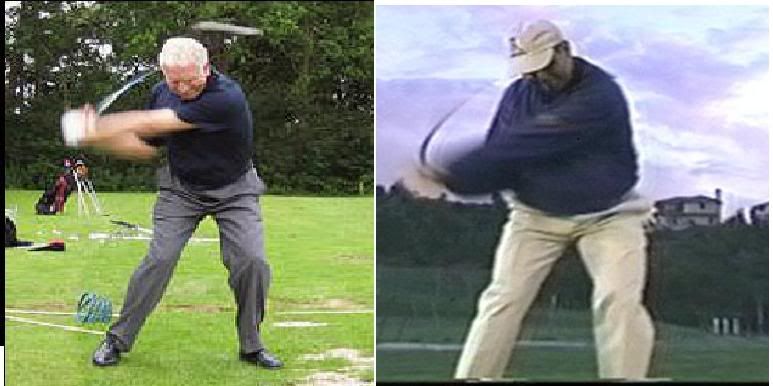 Quote:
|
Quote:
You are true . These are screen shots and the DEGREE of bent is shutter speed issue. My purpose was about KEEPING the lag from top to impact and these photos, for me , seems to illustrate that Bobby is doing it pretty well. Friendly PM |
You are a big guy
Leo,
Your swing video shows that you are a big strong guy. Please take your stiff (or better) shafted driver. Grip it in any fashion you like. Rest it against anything you like and produce an 8 inch deflection. This video would suggest a greater deflection than that if you wish to believe in it. I believe that Bobby is Superman! Golfie |
Toe Up?
Quote:
Can you please elaborate on this statement..."The shaft is bent so that it is toe up, is it not?" |
Guys, if you think the shaft bending look by Bobby is a shutter speed issue, I suggest you try and film yourself with a moderate shutter speed camera (e.g. 1/1000) and see. The greater the blurriness the lower the shutter speed, or you can be using a high shutter speed but not enough light. With a shutter speed of 1/2000 which you can get on most cheap camcorders these days, there should be very little/no blurriness of the hands. Anyway, the fact is that Bobby has snapped quite a few XXX shafts when loading on the downstroke. Could it be that stiffer shafts are actually easier to break than whippy shafts if you're strong? I don't know...
|
Experiment
Quote:
I assume from your response that you tried the experiment and failed? Nuf said. There may be other issues with the photography. The only inages worth considering for this kind of evidence are stroboscopic. Over and out. Golfie |
Quote:
|
Toe up
Quote:
The clubhead has rotated to the plane. The transition bends the club shaft so the the toe effectively becomes marginally closer to the grip of the club - therefore I choose to say toe up. What good is that. The Lag that Homer believed in was that the shaft would be bent backwards prior to impact. This is a different bend. Golfie PS I wish I had Yoda's gift for writing clarity! |
Quote:
Can you please give references in the book regarding your statement above? Thanks :) |
Quote:
|
Quote:
|
Stressing the shaft
 In his book (How I play golf, Golf Digest editions) Tiger explain that they have had to use a special camera (65 frames per second) . So, these are not screen shots and it seems that the shaft is bendind;) Anyway, we are not on a photography site. But Clubead Lag is the "Secret of golf" , and sometimes pictures may be a good complement to assimilate knowledge. |
Quote:
|
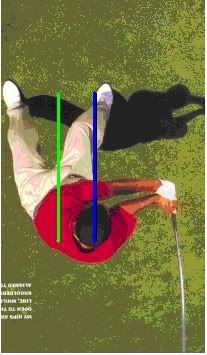 Hijacking my own thread, but check out that tripod, or lack thereof. His head is over his right foot (as opposed to the middle, according to the tripod concept)! The camera angle can make things look worse, but... |
Here it is
Quote:
While I do not know the book backwards and forwards. I would suggest 6-C-2-C as the paragraph you seek. Am I wrong to assume that Homer wishes to deliver a clubshaft that is stressed backward? Also I recall from some other site Homer's experiment where he put a mass (an ounce I think) and realized a bend of of a 1/8th (again fuzzy) of an inch. (Someone please help with the exct details if is is important!) From this he concluded that every 1/8 of an inch of clubhead lag (shaft lag) was as good as adding an ounce to the head of the club. BTW I don't think this discussion would help anyone's game. I just didn't want anyone to get excited about the massive toe-up "observed" bend from the original pic. Attempting to achieve such a thing would damage more than a few wrists. Golfie |
Teeter Tiger
Quote:
At this point in the Stroke, El Tigre appears to be leaning backwards -- his right ear is outside his right foot -- in an attempt to hit 'up' through Impact. :confused: This could well be the case if his intention was to minimize the Compression Leakage of Backspin (and its quid pro quo...[b]control). On the other hand, at the same point in the Stroke, the back view photo (below) in phimaynard's original post shows the right ear to be just in front of his right knee and well inside the Stance. BTW, another way to hit 'up' is to respect the geometry of the Stroke by locating the Head in the center of the Stance through Impact and the Ball forward of Low Point. As always... Your choice. |
Yes shafts do bend
Quote:
Do you think that the direction in bend that Tigers picture show will be useful per 6-C-2-C given that the clubshaft will rotate 90 degrees before imnpact Thank you for the Homer quote as well. Golfie |
wheres Compdas imitation of shaeffers swing?
|
Quote:
Interesting is that the deflection of the clubshaft in the pictures shown is in fact the opposite (for the most part) that of the direction of clubhead droop. Backwards would be the deflection at impact that is desired. It was once or maybe still is stated that this backward deflection would be timed to release at impact, adding to the ball's velocity. This is not an accurate concept for practical application nor is it what Homer has suggested. Tongzilla intial post has really left eveyone hanging. How does the flexing, stressing the clubshaft in the direction shown in the picture (effectively bending the shaft so the toe would move upward) while PP#3 is on the aft of the shaft, 90* out of line with this movement? I would respectifully submit that the clubshaft stress in these pictures are not 'clubhead lag' and this is something that is more common for a swinger than a hitter to experience. Also I believe on reason Homer suggested using the stiffest shaft possible was to over come this phenomenon, which can lead to inconsistencies. I should add.. This phenomenon that is shown is the change is direction at the top or end of the swing to the start down. The acceleration would be proportional to the shaft flex and force applied. The longer into the downstroke the acceleration continues to increase the more the shaft will be stressed. As the acceleration levels off the prestress will decrease. |
Quote:
http://asafgolf.free.fr/images/golf/...profil1234.jpg http://asafgolf.free.fr/images/golf/...er_dos1234.jpg http://asafgolf.free.fr/images/golf/...r_face1234.jpg http://asafgolf.free.fr/images/golf/...dessus1234.jpg BTW Lynn, Could you elaborate on this? (the bold part): "At this point in the Stroke, El Tigre appears to be leaning backwards -- his right ear is outside his right foot -- in an attempt to hit 'up' through Impact. This could well be the case if his intention was to minimize the Compression Leakage of Backspin (and its quid pro quo...control)." |
comdpa swing
Quote:
|
Quote:
Yes, everything else being equal, the more stress you place on the shaft, the more Effective Mass, hence more Power. However, I do not think the visual bend you see in the shaft is necessarily beneficial. Someone with more equipment knowledge could elaborate maybe. |
An Explanation
The bend in the shaft will occur in a direction opposite to the applied force. The direction of the applied force should remain constant throughout the stroke, however the clubface orientation changes as it gets squared through impact. At that point, the bend (direction of bend relative to an unstressed shaft) in the clubshaft would now be perpedicular to the clubface (approximately) even though it started out somewhat parallel at the top.
|
Quote:
I see that you ave a taste for good sites;) French golf sites are not a lot and ASA is a funny site for planes and golf fans Have a look to "photomontages". Some funny pictures Amitiés... Pm |
Hush now...
Quote:
|
Quote:
http://www.truetemper.com/shaftlab/profile.html Please also note that the shaft is completely unloaded at impact. Only centrifugal acceleration and mass velocity is at work, and the toe of the club is pointing down. Don't underestimate the power of centrifugal force regarding impact deceleration resistance! The prestressing of course happens because active torq is applied. The torque causes a clubshaft bend that has a similar effect as an increased wrist cock. That in itself will contribute to increased swing speed. Back to the pictures of Sergio: With the same swing and even stiffer shaft, the torque in the wrist cock would increase because the shaft wouldn't bend as much. That torque increase would in fact lead to reduced swing speed - as in clubhead throw away. As a general rule, big wrist cock (with a help of shaft bend) early in the swing will produce increased swing speed. Torque might increase swing speed if it is applied very late in the swing (as for hitters?)but that has no relation to what we are seing in this pictures. |
Good reply BerntR. So most the prestress is lost at Impact :(
Would you say Homer was wrong about the idea of a prestressed Clubshaft and how it helps the golfer, or we just don't completely understand what he's trying to say? |
Photo evidence
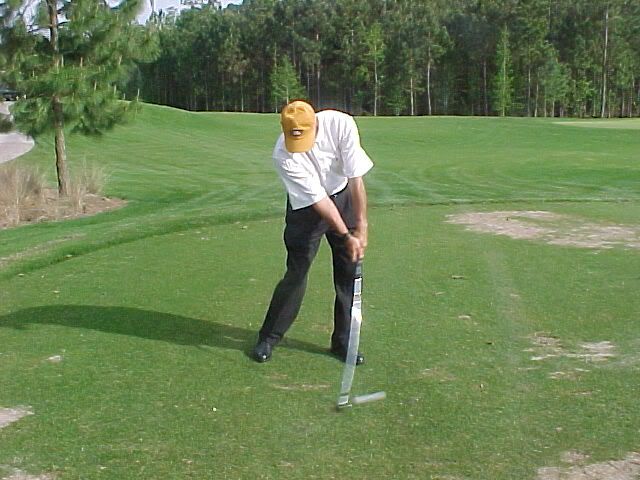 I think someone said earlier that the clubhead never lags behind during impact. |
Quote:
I think I will leave to other to comment on the Homer part of your question. |
| All times are GMT -4. The time now is 05:08 AM. |