
LynnBlakeGolf Forums

LynnBlakeGolf Forums (http://www.lynnblakegolf.com/forum/index.php)
-   The Golfing Machine - Basic (http://www.lynnblakegolf.com/forum/forumdisplay.php?f=16)
-   -   The Beauty of 12-5 (http://www.lynnblakegolf.com/forum/showthread.php?t=2062)

Trig 01-13-2006 11:01 AM

The Beauty of 12-5
 
If you haven't done so lately, take a long hard look at 12-5-0, 12-5-1, 12-5-2, and 12-5-3.

I start every range session progressing through this section and it really helps to get everything going in the right direction.

tongzilla 01-13-2006 11:30 AM

Trig,

Can you please highlight some of the pitfalls that people fall into when trying to utilise 12-5?

Martee 01-13-2006 11:40 AM

It is a thing of beauty....

I came up with a routine last year and used till I hurt my arm.

But I found that I could take it to the course. Hit a bad shot, just do a mini practice session (no ball of course) of a 1,2 and 3.

In doing this I can only recall once or twice hitting back to back bad shots.

I posted my routine in the practice forum along with some of the pitfalls.

Yoda 01-13-2006 11:53 AM

Boundaries And The Basic Motion Curriculum
 
Quote:

Originally Posted by tongzilla

Trig,

Can you please highlight some of the pitfalls that people fall into when trying to utilise 12-5?

We're talking about the three-stage Basic Motion Curriculum: Basic Motion (12-5-1); Acquired Motion (12-5-2); and Total Motion (12-5-3).

The first pitfall is failure to observe the boundaries of the respective stages. For example:

The Basic Motion is two feet back and two feet through. Unless this motion is made on the Putting or Chipping green, the Stroke is almost always too long. On the range, even after I demonstrate the correct length (and hit the ball no further than about thirty feet) the first thing I see from the student is a pitch shot. The Hands swing back at least waist high and finish at least waist high, and the Clubhead is above the Hands on both ends of the Stroke. This is Stage Two (Acquired Motion) not Stage One (Basic Motion).

So, in practicing Stage One and even Stage Two, go to the short game area. Give yourself a target just a few yards away. This is a Putt or a Chip Shot (with, at most, a few yards of carry). Practicing Stage One on the range is a very dull and expensive way to get the job done. But if you have no alternative, visualize a chipping green and a near target, otherwise your Stroke will be too long, and you will exceed the Basic Motion's boundary.

YodasLuke 01-13-2006 12:07 PM

12-5-1
 
Quote:

Originally Posted by Yoda
We're talking about the three-stage Basic Motion Curriculum: Basic Motion (12-5-1); Acquired Motion (12-5-2); and Total Motion (12-5-3).

The first pitfall is failure to observe the boundaries of the respective stages. For example:

The Basic Motion is two feet back and two feet through. Unless this motion is made on the Putting or Chipping green, the Stroke is almost always too long. Even after I demonstrate the correct length (and hit the ball no further than about thirty feet) the first thing I see from the student is a pitch shot. The Hands swing back at least waist high and finish at least waist high, and the Clubhead is above the Hands on both ends of the Stroke. This is Stage Two (Acquired Motion) not Stage One (Basic Motion).

The guy from Nashville had the same problem. But, I gave him such a short chip, he couldn't take it more than two feet back.

Trig 01-13-2006 12:12 PM

I would also add...
 
Quote:

Originally Posted by Yoda
We're talking about the three-stage Basic Motion Curriculum: Basic Motion (12-5-1); Acquired Motion (12-5-2); and Total Motion (12-5-3).

The first pitfall is failure to observe the boundaries of the respective stages. For example:

The Basic Motion is two feet back and two feet through. Unless this motion is made on the Putting or Chipping green, the Stroke is almost always too long. Even after I demonstrate the correct length (and hit the ball no further than about thirty feet) the first thing I see from the student is a pitch shot. The Hands swing back at least waist high and finish at least waist high, and the Clubhead is above the Hands on both ends of the Stroke. This is Stage Two (Acquired Motion) not Stage One (Basic Motion).

The other thing to note is Stage One has zero pivot.

Stage Two has zero pivot EXCEPT shoulder turn. Stroke length takes focus just as in Stage One and the right forearm goes no further than parallel to the ground.

So I think the major pitfalls are making the stroke too long and using pivot/too much pivot in Stage One and Two.

tongzilla 01-13-2006 12:32 PM

How many Accumulators should one use for 12-5-1?

Trig 01-13-2006 12:39 PM

Stage Two (Acquired Motion) question
 
How far should the follow through go during 12-5-2 Acquired Motion? I normally practice it with my arms going to Both Arms Straight. I do it both with and without a finish swivel but not sure this is correct. When I add the finish swivel, I get a bit higher ball flight and a bit more carry.

Homer references 6-4-A for the follow-through with 12-5-2 and I believe Both Arms Straight is the correct way to interpert this reference.

Please correct me if I'm wrong about this. :D

Trig 01-13-2006 12:46 PM

Hmmm....
 
Quote:

Originally Posted by tongzilla
How many Accumulators should one use for 12-5-1?

Good question. Homer explicity says to zero out accumulator #3. So the answer is less than 4!

If I think about it, there is no wrist cock either, so that eliminates #2.

I think the answer is 2. You should use accumulator #1 and #4 while executing 12-5-1.

Yoda 01-13-2006 12:51 PM

Basic Motion Mastery -- Step By Step
 
Once you know how far back and through to swing, the next pitfall is in knowing what to swing.

Start with your Hands only. :cool:

Swing continuously...Back and through and back and through and back and through. Keep your Feet Flat and your Head Stationary. The Left Arm should be straight, the Left Wrist Flat and the Right Elbow should bend. Your Body should move only as necessary to accomodate the motion of your swinging Hands.

When you've got this down pat, make the same motion using a dowel. Run the shaft up your the Left Forearm. This will help keep your Left Wrist Flat and your Hands swinging through 'Impact.' Without a Clubhead to flip or a Ball to hit 'at,' your Hands will quickly learn their assignments.

When you can do this, begin making the same motion with a Club (but without a Ball). Grip the Club down a bit, and anchor the shaft against the Left Forearm until you can keep your Left Wrist Flat and steady throughout the Stroke.

When the above steps have been mastered, you have prepared yourself properly for the execution of a Golf Shot.

Yoda 01-13-2006 12:58 PM

One Arm Accumulator For The Basic Motion
 
Quote:

Originally Posted by tongzilla

How many Accumulators should one use for 12-5-1?

Stage One of the Basic Motion Curriculum utilizes only one Power Accumulator (Single Barrel Stroke). And that Accumulator must be an Arm Accumulator: Either the Left Arm (#4 / Pull) or the Right Arm (#1 / Push). The Hand Accumulators -- Left Wrist (Cock and Uncock) and the Left Hand (Turn and Roll) -- are introduced in Stage Two (Acquired Motion).

rchang72 01-13-2006 04:41 PM

Quote:

Originally Posted by Yoda
Stage One of the Basic Motion Curriculum utilizes only one Power Accumulator (Single Barrel Stroke). And that Accumulator must be an Arm Accumulator: Either the Left Arm (#4 / Pull) or the Right Arm (#1 / Push). The Hand Accumulators -- Left Wrist (Cock and Uncock) and the Left Hand (Turn and Roll) -- are introduced in Stage Two (Acquired Motion).

Should you only use the accumulator for your desired/natural stroke pattern (i.e. #4 for swingers, #1 for hitters) or alternate?

phimaynard 01-13-2006 05:27 PM

12-5 and Yoda videos
 
Quote:

Originally Posted by Trig
If you haven't done so lately, take a long hard look at 12-5-0, 12-5-1, 12-5-2, and 12-5-3.

I start every range session progressing through this section and it really helps to get everything going in the right direction.

Trig
I do the same since i have uploaded "A Lesson with Yoda - Collin Neeman"
video (specially chapter 1,2 and 3)
The video incited me to reread 12-5 chapters.
Right from this time ALL my practice sessions, start as yours and I can attest that you are totally right.
These are not only the best foudations for a solid golf swing, but my short game have really improved +++.
I stil have some problem with 12_5_3 (Pivot , Swivel...). But maybe this will be the subject of a futur post.
Thanks
Pm

tongzilla 01-13-2006 05:57 PM

Quote:

Originally Posted by Yoda
Stage One of the Basic Motion Curriculum utilizes only one Power Accumulator (Single Barrel Stroke). And that Accumulator must be an Arm Accumulator: Either the Left Arm (#4 / Pull) or the Right Arm (#1 / Push). The Hand Accumulators -- Left Wrist (Cock and Uncock) and the Left Hand (Turn and Roll) -- are introduced in Stage Two (Acquired Motion).

So does that mean the Club must be gripped in the cup of the left hand to zero out Accumulator #3? Hmm...that's quite unnatural for me except for putting.

Trig 01-13-2006 08:18 PM

???
 
Quote:

Originally Posted by Yoda
Stage One of the Basic Motion Curriculum utilizes only one Power Accumulator (Single Barrel Stroke). And that Accumulator must be an Arm Accumulator: Either the Left Arm (#4 / Pull) or the Right Arm (#1 / Push). The Hand Accumulators -- Left Wrist (Cock and Uncock) and the Left Hand (Turn and Roll) -- are introduced in Stage Two (Acquired Motion).

The book references both accumulator #4 (9th component) and accumulator #1 (12th component). Why did Homer reference both of these accumulators in 12-5-1 if we are only using one?

Martee 01-13-2006 08:29 PM

Quote:

Originally Posted by Trig
The book references both accumulator #4 (9th component) and accumulator #1 (12th component). Why did Homer reference both of these accumulators in 12-5-1 if we are only using one?

I believe if you go back and read 12-5-0, it states that 'Where applicable, interpret the items per the basic Stroke Pattern, that is, Hitting or Swinging. Either 12-1 OR 12-2 -- not both atthe same time.

Yoda 01-13-2006 08:48 PM

The Basic Motion -- Pull Or Push
 
Quote:

Originally Posted by Trig

The book references both accumulator #4 (9th component) and accumulator #1 (12th component). Why did Homer reference both of these accumulators in 12-5-1 if we are only using one?

Either the Left Arm (Pull / Swinging) or the Right Arm (Push / Hitting) is the Active Direct Drive of the Basic Motion Stroke. The other is Passive and supplies merely motion. But, no matter which supplies the Active Direct Drive, the Left Arm swings and the Right Elbow bends.

The Active Direct Drive is the player's choice per the Basic Patterns of 12-1-0 (Hitting) and 12-2-0 (Swinging). A bystander cannot tell which Force (Pull or Push) is being employed. Study 10-11-0-1 and 10-11-0-4.

tongzilla 01-13-2006 08:50 PM

Why is Pressure Point #2 used in 12-5-1 if there is no Accumulator #2?

Trig 01-13-2006 09:07 PM

Right
 
Quote:

Originally Posted by Yoda
Either the Left Arm (Pull / Swinging) or the Right Arm (Push / Hitting) is the Active Direct Drive of the Basic Motion Stroke. The other is Passive and supplies merely motion. But, no matter which supplies the Active Direct Drive, the Left Arm swings and the Right Elbow bends.

The Active Direct Drive is the player's choice per the Basic Patterns of 12-1-0 (Hitting) and 12-2-0 (Swinging). A bystander cannot tell which Force (Pull or Push) is being employed. Study 10-11-0-1 and 10-11-0-4.

Got it. Depends if you Hit or Swing! Duh!](*,)

Yoda 01-13-2006 11:10 PM

Drag Or Drive -- Pick A Pressure Point
 
Quote:

Originally Posted by tongzilla

Why is Pressure Point #2 used in 12-5-1 if there is no Accumulator #2?

For Swingers, with or without Wristcock, the #2 Pressure Point Drag Loads the Secondary Lever (the Club / 6-A-3).

For Hitters, with or without Wristcock, the #3 Pressure Point Drive Loads the entire Primary Lever Assembly (the Left Arm and Club / 6-A-2).

12 piece bucket 01-13-2006 11:10 PM

Gettin' your $$$'s worth . . .
 
Quote:

Originally Posted by Yoda
Practicing Stage One on the range is a very dull and expensive way to get the job done. But if you have no alternative, visualize a chipping green and a near target, otherwise your Stroke will be too long, and you will exceed the Basic Motion's boundary.

If the range isn't too busy, dump your balls out and chip to the range basket. Pick up 'em up . . . chip 'em again and again and again.

tradekid 01-14-2006 12:37 AM

Depending on their pricing structure indoor golf domes are great for this reason alone. There is a dome near me where they have a short game area which you can use for FREE. Unlimited balls. Then you can go to a hitting station where you're only charged by the amount of time you spend in the station. Again, unlimited balls. Besides, it's only 90 yards to the other side of the dome. I find hitting drivers in domes a waste of time.

tongzilla 01-14-2006 05:53 AM

Should PP#2 really be in 12-5-1?
 
Quote:

Originally Posted by Yoda
For Swingers, with or without Wristcock, the #2 Pressure Point Drag Loads the Secondary Lever (the Club / 6-A-3).

For Hitters, with or without Wristcock, the #3 Pressure Point Drive Loads the entire Primary Lever Assembly (the Left Arm and Club / 6-A-2).

So I take it that Hitters can say goodbye to Pressure Point #2.

Also, you said earlier that Accumulators #2 and #3 should be zeroed out when using 12-5-1. Which means the club should be gripped in the cup of the left hand (rather than in the heel pad as usual). With that in mind, Pressure Point #2 (last three fingers of the left hand) isn't even on the club! So how can PP#2 be used even for the Swinger?

Thanks for your clarification Yoda :p

Martee 01-14-2006 10:32 AM

Quote:

Originally Posted by tongzilla
So I take it that Hitters can say goodbye to Pressure Point #2.

Also, you said earlier that Accumulators #2 and #3 should be zeroed out when using 12-5-1. Which means the club should be gripped in the cup of the left hand (rather than in the heel pad as usual). With that in mind, Pressure Point #2 (last three fingers of the left hand) isn't even on the club! So how can PP#2 be used even for the Swinger?

Thanks for your clarification Yoda :p

You got me wondering now too. I don't understand why you would adjust the grip different for 12-5-1, 12-5-2 and 12-5-3? I may have this wrong, but I havent been doing it this way and when I demonstrated this with Yoda, I don't believe he had me change, gotta go back to notes here.

Yoda 01-14-2006 01:23 PM

More On Pressure Points -- Hitting And Swinging
 
Quote:

Originally Posted by tongzilla

So I take it that Hitters can say goodbye to Pressure Point #2.

Other than the normal pressure necessary to secure the Left Hand Grip (1-L #3), the Hitter does not employ Pressure Point #2. In Full Strokes, the Swinger Loads the Left Wrist (and Pressure Points #2 and #3) to Drag centrifugally the Secondary Lever (the Club only). The Hitter Loads the Right Elbow (and Pressure Points #1 and #3) to Drive muscularly the Primary Lever (the Left Arm and Club). The latter is true even in Wristcock Strokes: Pressure Point #3 drives the #2 Accumulator (as opposed to the Swinger's normal application of the #2 Pressure Point driving the associated #2 Power Accumulator). This illustrates the Interchangeability of Power Accumulators and Pressure Points (10-11-0-5).

In the Stage One Basic Motion, there is no Left Wristcock. Hence, the Primary Lever Assembly remains in its In Line condition (Centrifugal Momentum 2-K#2). The player then uses either (1) the Left Arm to Pull the Secondary Lever through Impact (Swinging); or (2) the Right Arm to Push the Primary Lever through Impact (Hitting).

The Swinger Pulls the Secondary Lever toward the Plane Line centrifugally (as if the Clubshaft was a piece of rope) via Pressure Point #2. The Hitter Pushes the Primary Lever toward the Plane Line muscularly (as if the Left Arm and Clubshaft were one solid piece of board) by the thrust of the Right Elbow against Pressure Point #3.

Hitter's caveat:

Normally, the Left Arm is driven by the Thrust of the #1 Accumulator (Right Elbow) against the #1 Pressure Point (the heel of the Right Hand against the Left Hand thumb). Simultaneously, the Clubshaft is driven also by the Right Elbow but now against Pressure Point #3 (the right forefinger).

When only Pressure Point #3 is employed, the Right Elbow must drive both the Left Arm and the Clubshaft using that lone Pressure Point (1-L #7). This means that the Acceleration Thrust must be applied equally against both the Left Arm and Club (and not merely the Club alone). Otherwise, the Left Wrist Bends, the Club swings forward independently of the Left Arm and the shot is lost (1-L #8 ).

Yoda 01-14-2006 01:36 PM

Pressure Point #2 With Zero #3 Accumulator
 
Quote:

Originally Posted by tongzilla

Also, you said earlier that Accumulators #2 and #3 should be zeroed out when using 12-5-1. Which means the club should be gripped in the cup of the left hand (rather than in the heel pad as usual). With that in mind, Pressure Point #2 (last three fingers of the left hand) isn't even on the club! So how can PP#2 be used even for the Swinger?

Pressure Point #2 secures the Left Hand Grip to the Club. When the Club is placed in the cup of the Hand (to zero Accumulator #3), the securing Pressure is against the tips of the fingers and On Plane.

tongzilla 01-14-2006 02:15 PM

Thanks for your clarification Yoda :) "...tips of the fingers..." I mean who would've guessed that!

Moving on...

What the heck is Foot Loading (number 5 in the list) doing in 12-5-1? Surely that violates the "zero Pivot" (just enough to accomodate motion of the Hands) condition, no?

Another note: I think there's an error regarding the Reference number for 'Pace' (component number 19). 2-G talks about Hinge Motion which has everything to do with Rhythm, not Pace. Shouldn't that be replaced with the reference 6-P-0 instead?

annikan skywalker 01-14-2006 03:44 PM

Foot Loading is halting the backstoke from the feet...I've heard it called "Flat Loading " your feet from a certain "AI"....so with zero pivot load your feet..."FLAT" put a downward pressure "Down" to keep the feet "Flat"....

EdZ 01-15-2006 12:45 PM

Quote:

Originally Posted by annikan skywalker
Foot Loading is halting the backstoke from the feet...I've heard it called "Flat Loading " your feet from a certain "AI"....so with zero pivot load your feet..."FLAT" put a downward pressure "Down" to keep the feet "Flat"....

So basically this is utilizing a 'full radius' with a short stroke? (the extension of the radius to the feet)

EdZ 01-15-2006 12:50 PM

Quote:

Originally Posted by Yoda
Other than the normal pressure necessary to secure the Left Hand Grip (1-L #3), the Hitter does not employ Pressure Point #2. In Full Strokes, the Swinger Loads the Left Wrist (and Pressure Points #2 and #3) to Drag centrifugally the Secondary Lever (the Club only). The Hitter Loads the Right Elbow (and Pressure Points #1 and #3) to Drive muscularly the Primary Lever (the Left Arm and Club). The latter is true even in Wristcock Strokes: Pressure Point #3 drives the #2 Accumulator (as opposed to the Swinger's normal application of the #2 Pressure Point driving the associated #2 Power Accumulator). This illustrates the Interchangeability of Power Accumulators and Pressure Points (10-11-0-5).

In the Stage One Basic Motion, there is no Left Wristcock. Hence, the Primary Lever Assembly remains in its In Line condition (Centrifugal Momentum 2-K#2). The player then uses either (1) the Left Arm to Pull the Secondary Lever through Impact (Swinging); or (2) the Right Arm to Push the Primary Lever through Impact (Hitting).

The Swinger Pulls the Secondary Lever toward the Plane Line centrifugally (as if the Clubshaft was a piece of rope) via Pressure Point #2. The Hitter Pushes the Primary Lever toward the Plane Line muscularly (as if the Left Arm and Clubshaft were one solid piece of board) by the thrust of the Right Elbow against Pressure Point #3.

Hitter's caveat:

Normally, the Left Arm is driven by the Thrust of the #1 Accumulator (Right Elbow) against the #1 Pressure Point (the heel of the Right Hand against the Left Hand thumb). Simultaneously, the Clubshaft is driven also by the Right Elbow but now against Pressure Point #3 (the right forefinger).

When only Pressure Point #3 is employed, the Right Elbow must drive both the Left Arm and the Clubshaft using that lone Pressure Point (1-L #7). This means that the Acceleration Thrust must be applied equally against both the Left Arm and Club (and not merely the Club alone). Otherwise, the Left Wrist Bends, the Club swings forward independently of the Left Arm and the shot is lost (1-L #8 ).


This one should go in the 'sticky' category - wonderful post!

Yoda - does this difference indicate then that a hitter may actually be better off with zero accumulator #2, and a swinger with 'max' accumulator #2 (Hogan)? It would certainly seem to differentiate loading preferences being near opposites of each other. The swinger with the 'early' set perhaps.

Yoda 01-15-2006 01:47 PM

Why Zero #3 Accumulator In The Basic Motion?
 
Quote:

Originally Posted by Martee

I don't understand why you would adjust the grip different for 12-5-1, 12-5-2 and 12-5-3?

Actually, the major alignments of the Strong Single Action Grip (10-2-B) do not change in the Basic Motion Stroke of 12-5-1. The Left Hand remains Vertical; the Right Hand remains Vertical; and both Pressure Points #2 and #3 remain on the aft side of the Clubshaft and On Plane. There is, however, a distinct difference (from the norm) in the alignment of the Clubshaft with the Left Arm. This is done deliberately and for a dual purpose.

With the Club located normally under the heel of the Left Hand, any Turn and Roll of the Left Wrist causes the Clubhead to 'travel' as it seeks to maintain its In Line condition with the Left Arm. This is not Lever Extension (the shortening and lengthening of the Swing Radius via the Left Wristcock). Instead, it is Rhythm -- the true Overtaking Action (of the Hands by the Club) during the Release Interval ('Through the Ball').

Conversely, when the Club is gripped in the cup of the Left Hand (or, alternatively, when the Left Wrist is fully Uncocked), any Turn and Roll of the Left Wrist actuates only the Clubface (and not the Clubhead). Thus, the Overtaking Action with its Clubhead travel and Rotational Power (4-C) is eliminated (6-B-3-A). And this, by Basic Motion definition, is our objective in a One Accumulator Stroke that uses either the Left Arm or the Right as the sole Power Source.

Also, the Basic Motion of 12-5-1 introduces Hand Motion (Items #20 and #21), i.e., the Hinge Action (Clubface Control) and its Rhythm (Left Arm and Clubshaft remaining In Line). With Zero #3 Accumulator, all three Hinge Actions have identical Clubhead travel distances to the end of the Follow-Through (Both Arms Straight position) and hence, identical Rhythms. This allows the player to focus only on the Left Wrist alignment necessary to produce the desired Clubface Motion without concern for Clubhead travel differences.

So, to limit Clubhead Power and to simplify Clubface Control, Accumulator #3 is eliminated in the Basic Motion.

Yoda 01-15-2006 02:03 PM

Foot Loading At Address
 
Quote:

Originally Posted by tongzilla

What the heck is Foot Loading (number 5 in the list) doing in 12-5-1? Surely that violates the "zero Pivot" (just enough to accomodate motion of the Hands) condition, no?

The reference here is to the basic Address Position loading of the Feet. Per 7-17:

"...an even distribution between both Feet but with enough on the heels to allow the toes to be lifted up momentarily without altering the distribution between the toe and heel."

This loading is in stark contrast to the Foot loading recommended by the Golf Digest folk back in the '70s and '80s: Enough weight on the balls of the Feet to allow you to tap your heels!

Yoda 01-15-2006 02:57 PM

Actuating The #2 Accumulator
 
Quote:

Originally Posted by EdZ

Yoda - does this difference indicate then that a hitter may actually be better off with zero accumulator #2, and a swinger with 'max' accumulator #2 (Hogan)? It would certainly seem to differentiate loading preferences being near opposites of each other. The swinger with the 'early' set perhaps.

For Maximum Power, both Hitter and Swinger need the mechanical advantage afforded by the Wristcock. The difference between the two is in how that Assembly is actuated: The Hitter uses the Right Elbow to Cock and Uncock the Left Wrist. The Swinger uses Centrifugal Force.

Regarding a "'max' #2 Accumulator," the Wrist is considered to be in a Cocked condition any time it moves beyond the Level (a straight line is formed from the wrist bone to the edge of the hand) to its maximum Cocked condition. It matters little how much that Wristcock varies from player to player. What is important is that if the Wrist is Cocked, it should be fully Cocked. This eliminates the 'wobble' inherent in the less-than-full condition.

Regarding Hogan's Wristcock, remember, the Wrist Cock is a Perpendicular Motion. It is not Wrist Bend, a Horizontal Motion. When the Grip is taken with the Left Hand Turned, the amount of Left Wrist Turn properly becomes Left Wrist Bend at the Top (4-D-1). This is a Double Wrist Cock (10-18-B), and it is restricted to true Swingers (those who depend solely upon Centrifugal Force to align both Clubface and Clubshaft).

Ben Hogan employed this Turned Left Hand and Double Wristcock procedure in his early days, and it is readily seen in the sequence photographs of his first book, Power Golf. Later, in an effort to combat his tendency to Hook, he made two significant changes to his Grip: First, he moved the Left Hand from Turned to Vertical. Normally, this Grip produces a Single Action -- Wristcock Only. However, Hogan added a Wrist Bend at the Top thinking that he could now Roll his Wrists through Impact as hard as he wanted, and the Ball still would not Hook.

Warning: This is the Land of the Meateaters, and only The Brave and Supremely Talented dare enter.

bray 01-15-2006 03:26 PM

Quote:

Originally Posted by Trig
Good question. Homer explicity says to zero out accumulator #3. So the answer is less than 4!

If I think about it, there is no wrist cock either, so that eliminates #2.

I think the answer is 2. You should use accumulator #1 and #4 while executing 12-5-1.

Trig,

I was trying to figure out how Acc. #4 was involved in a stage one stroke. Then I referred to 6-B-4-0 and read this; "Left Arm Power in any form or amount can still be considered #4 Accumulator Action."

So, yes Accumulator #4 is involved in the two barrel stage 1 motion.

I learned something today, now back to answering the pro shop phone.

Soting through the Duffer's Bible.

B-Ray

tongzilla 01-15-2006 03:46 PM

Quote:

Originally Posted by bray
Trig,

I was trying to figure out how Acc. #4 was involved in a stage one stroke. Then I referred to 6-B-4-0 and read this; "Left Arm Power in any form or amount can still be considered #4 Accumulator Action."

So, yes Accumulator #4 is involved in the two barrel stage 1 motion.

Hmm...so for 12-5-1, when Homer lists Acc #4, was he referring to independent Left Arm Power, or Body Power? The latter will clearly make the zero pivot requirement harder to achieve. But it also has mechanical advantage (which is pretty irrelevant for 12-5-1).

Yoda 01-15-2006 03:47 PM

The Basic Motion -- Always A One Accumulator Stroke
 
Quote:

Originally Posted by bray

I was trying to figure out how Acc. #4 was involved in a stage one stroke. Then I referred to 6-B-4-0 and read this; "Left Arm Power in any form or amount can still be considered #4 Accumulator Action."

So, yes Accumulator #4 is involved in the two barrel stage 1 motion.

The Basic Motion of 12-5-1 is a One Accumulator Stroke (Single Barrel, 10-4-A). And that one Accumulator is an Arm Accumulator, either the Left (10-4-A-4) or the Right (10-4-A-1). If the player chooses to use "Left Arm Power in any form or amount," then the Thrust is Centrifugal (6-C-0-4) and the Stroke is a Swing. If the player chooses to use the Right Arm to drive the Primary Lever (Left Arm and Club), then the Thrust is Muscular (6-C-0-1) and the Stroke is a Hit.

Both Accumulators are referenced in 12-5-1 because both Arms are in Motion -- one Active and the other Passive. And that Motion is identical, no matter which Arm actually drives the Stroke.

tongzilla 01-15-2006 03:52 PM

Quote:

Originally Posted by Yoda
It matters little how much that Wristcock varies from player to player. What is important is that if the Wrist is Cocked, it should be fully Cocked. This eliminates the 'wobble' inherent in the less-than-full condition.

I find that hard to swallow, except for full Power Strokes.

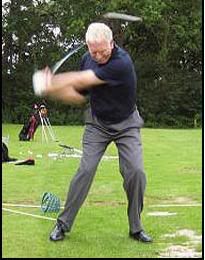
For example, when using 12-5-2, we introduce Accumulator #2.

Can you imagine this amount of Wrist Cock for a basic pitch shot?

Yoda 01-15-2006 05:15 PM

Power Regulation Versus Wrist Action
 
Quote:

Originally Posted by tongzilla

I find that hard to swallow, except for full Power Strokes.

For example, when using 12-5-2, we introduce Accumulator #2.

Can you imagine this amount of Wrist Cock for a basic pitch shot?


Leo,

Do not confuse the speed and sharpness of the above Maximum Power Loading Action (7-22) Driver Stroke with the Maximum Cocked Wrist (4-B-2) of the Pitch Shot. Also, remember that the Driver is the longest Club in the bag and accordingly has the Flattest Plane. The Pitch Shot, on the other hand, normally is played with the Sand Wedge, the shortest Club (except for the Putter) and is swung on a Steeper Plane. These facts, plus a slow shutterspeed, enhance the illusion of a 'greater than normal' Cocked Left Wrist.

Actually, the degree of Wristcock afforded by the Flat Left Wrist (Accumulator Lag / 6-C-0) is not all that great to begin with. And as I've stated, it is advisable to have maximum Wristcock when that Accumulator is employed in order to eliminate Power Package Wobble.

Maximum Wristcock does not mean maximum Accumulator #2 Power! It is true that varying the amount of 'Out-of-Line' will increase or decrease the amount of Power that ultimately can be Released (6-B-0). However, that does not mean that a full Wrist Cock demands full Power. To the contrary, Clubhead Power is a function of Effective Clubhead Mass and Clubhead Speed per 2-M-2. And this Power Regulation is totally under the conscious control of the player.

I might add that I play many of my Pitch Shots with the Left Wrist Level, especially when Hitting. Remember, 'daintiness is dangerous' and the shorter Stroke with its stronger Thrust has definite advantages (3-F-6, 6-C-2-D and 10-19-A).

Yoda 01-15-2006 05:32 PM

One Error And More
 
Quote:

Originally Posted by tongzilla

...I think there's an error regarding the Reference number for 'Pace' (component number 19). 2-G talks about Hinge Motion which has everything to do with Rhythm, not Pace. Shouldn't that be replaced with the reference 6-P-0 instead?

I have long agreed that Pace should reference 6-P-0. Also, in 12-5-3, Item #12 (Impact Fix) should read 7-8, not 7-3. And Item #10 in 12-5-2 should probably be Lag Loading, not Loading Action (else the Reference # should be changed to 10-22-B).

tongzilla 01-15-2006 06:08 PM

Quote:

Originally Posted by Yoda
I have long agreed that Pace should reference 6-P-0. Also, in 12-5-3, Item #12 (Impact Fix) should read 7-8, not 7-3. And Item #10 in 12-5-2 should probably be Lag Loading, not Loading Action (else the Reference # should be changed).

Thanks for the confirmation!

Moving on...

Does 12-5-2/3 include all the components before it (e.g. components in 12-5-3 includes all those in 12-5-2 and 12-5-1)?


The 1-L reference for 12-5-1 #15 (Pressure Point #3) is 1-L-7 and 1-L-12.

1-L-7: The Lever Assembly is driven by exerting pressure against it.
So for obvious reasons, I'm thinking this reference is for Hitters only. Hmmm...

1-L-12: Ball Speed is dependent on both before Impact and after Impact Clubhead Speed.
I'm thinking...PP#3 is usually assigned for sensing Clubhead Lag. And the prestressed shaft that comes with Clubhead Lag helps resist Impact Deceleration. Hmmm...


All times are GMT -4. The time now is 01:30 AM.