
|
Magic Of The Right Forearm / Elbow Action
Quote:
Are the Frozen Right Wrist and the Locked Left Wrist Hitting procedures? That would definitely be the traditional view. Hitting is all about Muscle Power, Thrust and Structure, and the terms 'Frozen' and 'Locked' -- while jarringly hard -- seem right at home in that environment. At the same time, they are at odds with the "soft hands" and "flexible wrists" widely viewed as the Swinger's birthright. So much so, in fact, that to suggest otherwise is revolutionary (if not heretical). But then Homer Kelley was that kind of guy. As discussed in my previous post, the term 'Locked' -- Webster: "rendered immovable" -- was slated for Homer's 7th edition. It denotes only that the Left Wrist -- other than in the Standard Adjusted Address (10-9-A) -- is 'Locked' into its Flat condition, i.e., it cannot produce any Horizontal Motion (Bending or Arching). Instead, it can produce only Perpendicular Motions (Wrist Cocking and Uncocking) and Rotational Motions (Turning and Rolling). To that extent, the Left Wrist may be considered 'Unlocked.' This 'Left Wrist Locked (in its Flat condition)' may be a tough concept for Swingers to handle, but to the extent they deviate from that precision alignment, quoting Homer, "They will pay a price." The word 'frozen' is no doubt even more controversial. What could be 'tighter' or 'harder' or more the antithesis of the lyrical Swinging Motion than something that is 'frozen?' So much so, that Homer himself had a hard time applying the term to Swingers early on. But as he came to a full understanding of the importance of the Flying Wedge Alignments and Structure (6-B-3-0-1), his view changed -- I have this discussion on tape -- and he came to believe that the Frozen Right Wrist serves Swingers equally well as Hitters. From the Third Edition's 10-18-0 'General' Section (applying to both Hitters and Swingers): "...the Right Wrist, if it moves at all, moves in accord with the Left Wrist. Ideally, it should be frozen in its Impact Fix Position -- preferably from the Top of the Stroke to well into, or through, the Follow-Through." [Bold by Yoda.] The term 'frozen' -- Webster: "rendered immobile" -- denotes that the Right Wrist is 'locked' -- that word again -- in its Level and Bent condition. In other words, it cannot produce any Perpendicular Motion or any Horizontal Motion (other than its Impact Fix Degree of Bend). Instead, it can produce only Rotational Motions (Turn and Roll). To the extent the Right Wrist deviates from that Frozen condition, the Clubface will be misaligned at Impact. The bottom line is that, as usual, Homer said exactly what he meant in terms that were unmistakably clear. Through Impact, your Left Wrist must be Flat, Level and Vertical, and your Right Wrist must be Bent, Level and Vertical. The best way to achieve this Ideal Impact Alignment is to permit during the Stroke only Left Wrist Perpendicular and Rotational Motions and Right Wrist Rotational Motions. And the way you do that is to Lock your Left Wrist in its Flat Condition and Freeze your Right Wrist into its Bent and Level condition early in the Stroke and then maintain those conditions until the end of the Follow-Through. Interestingly, I have thus far not mentioned Grip Pressure. That is because, within limits, Gripping ‘light’ or ‘tight’ is the player’s option. What matters is that the essential Wrist Conditions be maintained throughout the Stroke. And that requires a highly developed kinesthetic sense of Wrist Alignments, not necessarily a tight Grip. That said, the Hands are best viewed as strong, Educated Clamps attaching the Club to the Arms. Per 1-L #3, there should be “no wobble in the Clubshaft attachment.” The player with Uneducated Hands might do well with a lighter Grip Pressure because he may then be less likely to ‘horse’ the Club out of the correct alignments that Centrifugal Force is trying its best to produce. The skilled player, on the other hand, can use the tighter Grip Pressure to give his Educated Hands a more complete control of the Club throughout the Stroke. The Tight Grip is especially effective as resistance against the terrific forces of Impact Deceleration. Remember, per Isaac Newton’s Third Law (2-C-0), the Ball hits the Club just as hard as the Club hits the Ball. Said another way, and summing up this entire discussion… Impact is a place for Science, not “Seems as ifs.” |
Magic Of The Right Forearm / Elbow Action GM#4
Quote:
Tball, For the record, while I didn't present an exhaustive analysis, three of the last four paragraphs of my prior post addressed Grip Pressure. :oops::oops: Regarding your specific question, please answer the following questions: 1. Where is this slippage of the Club occurring -- Left Hand or Right Hand or both? 2. When is it occurring, e.g. at the Top? Release? Impact? 2. What Basic Grip are you using, e.g., 10-1-A (Overlap) or 10-1-D (Interlock)? 3. What Grip Type are you using, e.g. 10-2-B (Strong Single Action), 10-2-D (Strong Double Action), or one of the other five Types. 4. What is your current perceived Grip Pressure, light or tight? Does that pressure change markedly during the Stroke? 5. What is your current skill level, i.e., single-digit handicap, double-digit but below 18, or dreaded 'other.' Topic:Tom Tomasello |
Magic Of The Right Forearm / Elbow Action GM#7
Quote:
The Hands in their correct alignments absolutely operate as a precisely coordinated unit. Only by doing so are they able to maintain the alignments and structure of the Flying Wedges Assembly (6-B-3-0-1). For lighter Grip Pressures, your 'gauze' analogy is effective as far as it goes. I would suggest first wrapping the Right Hand, Wrist and Forearm separately -- better yet, put it in a cast (my personal Feel) -- to preclude any vertical or horizontal motions. It is also important that the 'gauze' not prevent the Left Wrist's Vertical Cocking and Uncocking Motions. Finally, to help a student find his own ideal Grip Pressure, I would suggest the student experiment with even tighter 'wraps.' |
Magic Of The Right Forearm / Elbow Action GM#9
Quote:
1. It is not only possible to maintain a Bent and Level Right Wrist while Cocking and Uncocking the Flat Left Wrist, it is mandatory. Study the Flying Wedges (6-B-3-0-1). 2. Maintaining the Right Wrist Bend guarantees a Flat Left Wrist, but only if the Right Wrist Bend is precisely the amount established at Impact Fix. If the Bend is less, the Left Wrist will be Bent. If more, it will be Arched. Be aware that the further Forward the Ball is positioned, the greater the amount of Right Wrist Bend. And the further back, the lesser the amount. 3. After the Follow-Through, the Flat Left Wrist Swivels back against the Plane and then Bends as the Right Wrist Flattens (Right Palm down to the face of the Plane). This is the reverse of their positions in the Backstroke. At the Finish, most really good players have restored the original Flying Wedge alignments, i.e., the Flat Left Wrist and the Bent Right Wrist and their perpendicular relationship to each other. Topic:Clubhead Lag Quote:
|
Magic of the Right Forearm/Elbow Action GM#29
Quote:
JG33, For all Strokes, the entire Flying Wedge Assembly -- Left Arm and Right -- remains intact at least through the end of the Follow-Through (the Both Arms Straight position). |
Magic Of The Right Forearm / Elbow Action GM#34
Quote:
Yes, I remember an article Ken did on the short game years ago where he put both wrists and forearms in casts. In addition to preventing any Left Wrist Bend, the Left Wrist/Forearm cast precluded the Wristcock. This would be another helpful image because you would rarely use the Wristcock -- the Velocity Accumulator (6-B-2) -- in a Single Barrel (10-4-A) Stroke. Incidentally, I have previously commented on the mistaken notion that maintaining the 'Locked' and 'Frozen' alignments requires a tight Grip Pressure. It is helpful to realize that the 'cast' that 'freezes' the Right Wrist in its Bent and Level Impact Fix alignment does not prevent the Wrist within that cast from remaining in an inert, unstressed condition from the Top through Impact per 4-D-1. In other words, the cast is one thing and the degree of tension in the Wrist is quite another. |
Magic Of The Right Forearm / Elbow Action GM#35
Quote:
Yes. Regardless of the Hinge Action employed, Clubhead Force and Motion is always On Plane at right angles to the Sweetspot (1-L #10 and #11) and also to the Clubshaft (7-11). At the Top, Hitters Drive Load (10-19-A) the Clubhead Lag Pressure with the No. 3 Pressure Point at right angles to the Aft side of the Shaft and that Loading is maintained through Impact. Swingers, on the other hand, Drag Load (10-19-C) the Lag Pressure at right angles to the Top of the Shaft. That Loading is maintained at least into Release, at which time the Swivel may or may not cause it to return to the Aft side of the Shaft (10-11-0-3). If it does not, the Swinger who began with a Strong Single Action Grip (10-2-B) has now changed to a Weak Single Action (10-2-A). |
Magic Of The Right Forearm / Elbow Action GM#71
Quote:
Vince, Ideally, the player establishes a Turned Shoulder Plane (10-6-B) at Impact Fix and positions the Right Forearm and Clubshaft on this Plane. Study this Right Forearm alignment in the pictures 9-2-2 #2 and 9-2-10 #2. Regarding the Right Wrist 'Release'...it has none. The Wrist Release is an Uncocking of the Left Wrist (2-P). Even though it is executed on an Inclined Plane, the Wristcock remains a Vertical motion (4-B-0/1/2/3) and it defines the plane of the Left Arm Flying Wedge (6-B-3-0-1). Any Flattening of the Right Wrist is a Horizontal Motion (4-A-0/1/2/3) that destroys the alignments of both the Right Arm and Left Arm Flying Wedges. The pictures below should help clarify things. Thanks to Golfingrandy for the photos and to Martee for his help on getting these up! 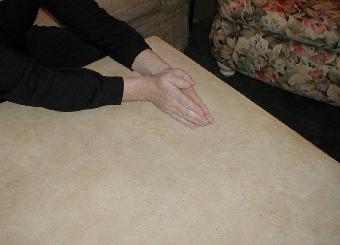 The Left Arm and Right Forearm Flying Wedges (Zero #3 Accumulator) 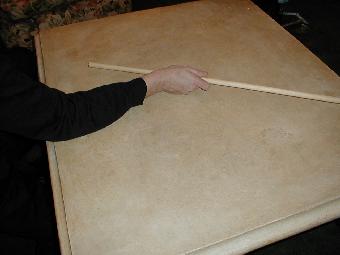 The Right Forearm Flying Wedge -- On Plane Forearm and Clubshaft 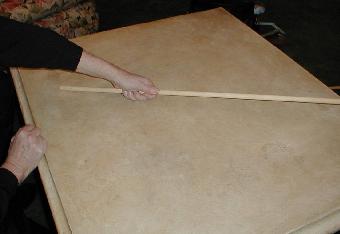 The Left Arm Flying Wedge -- Off Plane Forearm (with #3 Accumulator) and On Plane Clubshaft 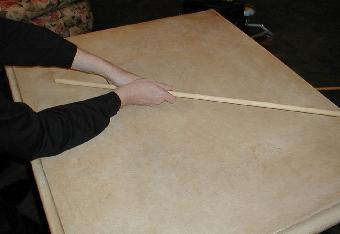 The Flying Wedges Assembly 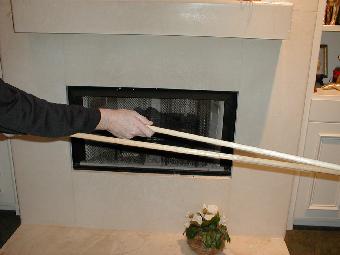 The On Plane Right Forearm Flying Wedge on a Horizontal Plane 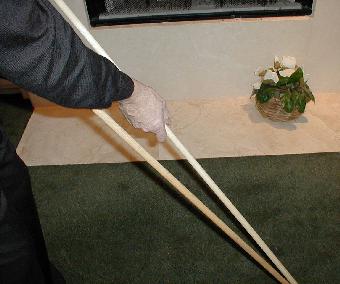 The Right Forearm Flying Arm Wedge lowered to an Inclined Plane |
GM#71 Contiinued
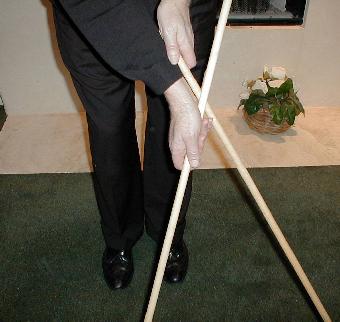 The Impact Alignment and Angle of Approach of the Right Forearm Wedge 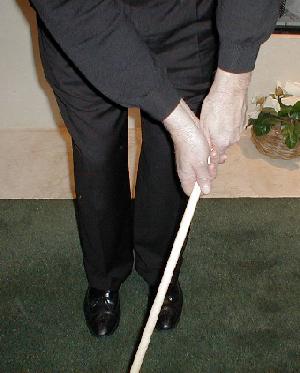 Impact Alignment of the Flying Wedges Assembly 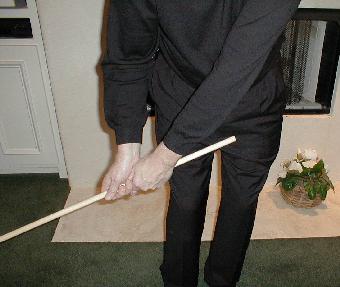 Flying Wedges Assembly in Start Up 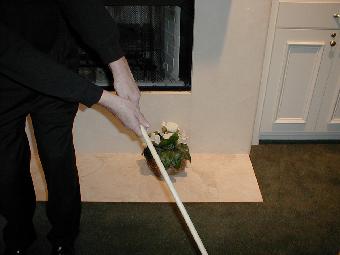 Flying Wedges Assembly at Follow-Through (Both Arms Straight) |
Magic Of The Right Forearm / Elbow Action GM#82
Quote:
Yes to both questions, Stan. However, the purpose of the photos was to illustrate the Flying Wedges Alignments -- Left Arm, Right Forearm and their collective Assembly -- not the Clubface Hinge Action or the Clubhead Physics of Rotation. |
| All times are GMT -4. The time now is 07:55 PM. |