I was thinking that what we needed was a thread for which beginners to TGM and LBG can go and find out about some of the basic concepts of the golfing machine.
So I decided to create this thread. Anyone is free to put across any major concept of the golfing machine, but I think it would serve beginners best if we could keep the thread 'from debate and discussion' but rather just allow people their thoughts on a subject and stop there and 'PM the poster' instead if you have problem with the inaccuracies so they can edit their post or start a new thread. Also try to keep any language in a simple form from which people just starting can understand.
If this thread goes well perhaps we could get trig to make it into a sticky....
Note: Feel free to offer suggestions on improvement for the article.... I plan to go over it again and edit it later anyhows...
Perhaps one of the most important concepts in the golfing machine is that of maintaining a 'stationary head'. Homer Kelley defines it as one of the three essentials to a precision golf stroke.
Lynn in one of his posts explained that there were many words that could of been used in its place if it was Homer Kelleys intention such as 'steady'..etc but he chose the word stationary which per the dictionary definition describes "fixed in space, not moving".
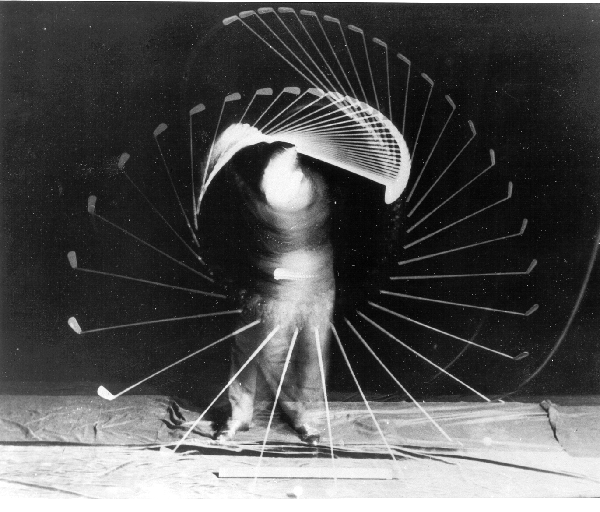
The principle underlying the reason why maintaining a stationary head is so good for your golf is 'centered arc'. Have a look at this strobe picture of Bobby Jones.
Notice how when the head remains pretty much stationary, it stabilises the motion of the left shoulder. The left shoulder is what could be described as a 'moving center' of the clubhead of which the left arm and clubshaft would form a radius of the stroke.
Because of the concept of centered arc, Homer Kelley said that there has to be some point at the top of the spine that must be kept stationary to stabilise the motion of the left shoulder and that can be either be a)the head or b) the point between the shoulders, but that the head was superior because of the advantages of visually being able to monitor.
Your perspective should never change during your stroke. You can use your eyes during the stroke to check. Like a camera that just moved, you can see it when it happens....
In order to be able to maintain a stationary head, it must be in its impact location to begin with. The idea is to go to impact fix (ill let someone else write on this) and maintain your head position throughout the stroke.
Historically most of the greatest players of all time used the word 'stationary' in their literature. Such names as Ben Hogan, Bobby Jones, Harry Vardon, Jack Nicklaus and many many more, instantly come to mind. Jack Nicklaus the winner of 18 majors called it "golfs unarguable fundamental" and felt it was so 'obvious' that he felt foolish having to write a chapter about it. Growing up his teacher used to grab his hair to drive this principle home to him.
However the head can move after impact once both arms are fully straight as it is healthier to the spine.
ALIGNMENT-The process of adjusting parts so that they are in proper relative position.
Here's a list that isn't all encompassing . . . we can go into further detail.
LEVEL
FLAT
PARALLEL
ON-PLANE
OFF-PLANE
IN-THE-PLANE-OF
DOWN PLANE
PERPENDICULAR
VERTICAL
RADIAL
RADIUS
ARC
CHORD
CIRCUMFERENCE
TANGENT
RAY
RIGHT ANGLES (90 degrees) TO
POINTING ALONG
45 DEGREES ACROSS
VERTICAL
HORIZONTAL
ANGLED
INCLINED
FLAT
BENT
ARCHED
COCKED
UNCOCKED
VERTICAL
TURNED
ROLLED
SWIVEL
FULLY EXTENDED
AHEAD OF
BELOW
PALM FACING
PALM FACING AWAY
AFT
LEANING
ON-LINE
CROSS-LINE
PUSH
PULL
12 Buck,
That is an impressive list. However, I should have put my question in context. Here goes:
Ted recently said to me that it didn't matter that he couldn't practice much; because his alignments are so good that when he does play, he plays well.
I was thinking that what we needed was a thread for which beginners to TGM and LBG can go and find out about some of the basic concepts of the golfing machine.
So I decided to create this thread. Anyone is free to put across any major concept of the golfing machine, but I think it would serve beginners best if we could keep the thread 'from debate and discussion' but rather just allow people their thoughts on a subject and stop there and 'PM the poster' instead if you have problem with the inaccuracies so they can edit their post or start a new thread. Also try to keep any language in a simple form from which people just starting can understand.
If this thread goes well perhaps we could get trig to make it into a sticky....
I've seen Yoda's video and where he discusses the right arm flying wedge in detail. I've in fact applied it to my own swing and noticed an improvement. Would anybody care to explain the left are flying wedge and the role of the left arm and shoulder in the TGM swing? And by the way based on the video and information I've seen on this site I'm a swinger.
I've seen Yoda's video and where he discusses the right arm flying wedge in detail. I've in fact applied it to my own swing and noticed an improvement. Would anybody care to explain the left are flying wedge and the role of the left arm and shoulder in the TGM swing? And by the way based on the video and information I've seen on this site I'm a swinger.
Imagine you had a big flat piece of cardboard glued to your right hand. If you moved you hand up and down like a karate chop that had no arm motion, the cardboard would rub against your forearm. That's okay. If you bend your right wrist, the board would come off your arm. That's a big NO-NO. Keep the board against your forearm at all times.
AKA, a flat right wrist. You can cock it and uncock it, but never bend it.
If you feel a little confused, I'm a lefty. Switch the words "left" and "right", and it'll make sense. Lefty's Revenge!
As far as the arm and shoulder, I'll let a swinger help you with that. As a hitter, all I try to do is apply extensor action, then let it feel as if it's numb.
That is an impressive list. However, I should have put my question in context. Here goes:
Ted recently said to me that it didn't matter that he couldn't practice much; because his alignments are so good that when he does play, he plays well.
That's what I was referring to.
Gotcha. Per 2-J-1 IMPACT ALIGNMENTS The geometry of all alignments stems form the Impact geometry requirements.
So what particular alignments are we talking about? First I think we should declare our intent. Per 2-0 our objective and intent is as follows:
The Principle of Golf is the “Line of Compression.”
The Mechanics of Golf is the production and manipulation of the “Line of Compression.”
Precision is recognizing and reconciling minute differentiations.
Briefly stated, it is necessary to find a way to compress the ball through a particular point along a particular line, and maintain this compression through the same particular point along this same particular line straight line, through the entire arc of the Impact Interval, and with geometrical precision for consistent control.
So the items critical to the intent/objective presented above have been presented to us in exquisite detail by Mr. K via the science of relationships - Geometry. Some of the critcal alignments that have been provided are easy to find The STAR SYSTEM TRIAD: the Three Imperatives (2-0) applying the Three Functions (1-L-A/B/C) through the Three Stations (12-3).
THE THREE IMPERATIVES
1. A “Flat” Left Wrist
2. A Clubhead Lag Pressure Point
3. A straight Plane Line
THE THREE FUNCTIONS
This Machine has three functions – to control A) the Clubshaft, B) the Clubhead and C) the Clubface.
A. The Inclined Plane is Clubshaft Control – See 2-F and 4-0
B. The Pressure Points are Clubhead Control – See 2-K and 4-0
C. The Left Wrist is Clubface Control – See 2-G and 4-0
THREE STATION TOTAL MOTION
A. Address
B. Top
C. Finish
All well and good. But since the all proper alignments arrived from Impact Geometry, what alignments was Ted refering to? I'm not Ted but I would submit the many of the alignments are with regards to his Right Side: Right Forearm Flying Wedge executing an "underhanded" motion
The Active Drive of Pressure Point #1 and the Indirect Drive of Pressure Point #2
A Cleared Right Hip
An engaged Right Forearm Extensor Action via Pressure Point #1
A Right Shoulder Moving DOWN-PLANE with the required Axis Tilt
A Right Foot that has not "popped up" from the ground
A Right Ankle that is rolled
A Right Hand that is executing Paddlewheel Motion vertical to the Inclined Plane
A Bent Right Elbow moving to a straight Right Arm at Follow-Thur resulting in a fully uncocked Left Wrist (Full Lever Extension)
A LEVEL BENT UNSTRESSED RIGHT WRIST
A "Stump" of a Right Forearm in the Plane-Of the Clubshaft executing a strong DOWNWARD PUNCH against the Right Shoulder
__________________
Aloha Mr. Hand
Behold my hands; reach hither thy hand
Last edited by 12 piece bucket : 03-29-2006 at 11:13 PM.
Shouldn't call you 12 piece, more like party platter, Original and Extra Crispy! That last post is almost a what we believe/why we believe full catechism of TGM.
Imagine you had a big flat piece of cardboard glued to your right hand. If you moved you hand up and down like a karate chop that had no arm motion, the cardboard would rub against your forearm. That's okay. If you bend your right wrist, the board would come off your arm. That's a big NO-NO. Keep the board against your forearm at all times.
AKA, a flat right wrist. You can cock it and uncock it, but never bend it.
If you feel a little confused, I'm a lefty. Switch the words "left" and "right", and it'll make sense. Lefty's Revenge!




 Linear Mode


