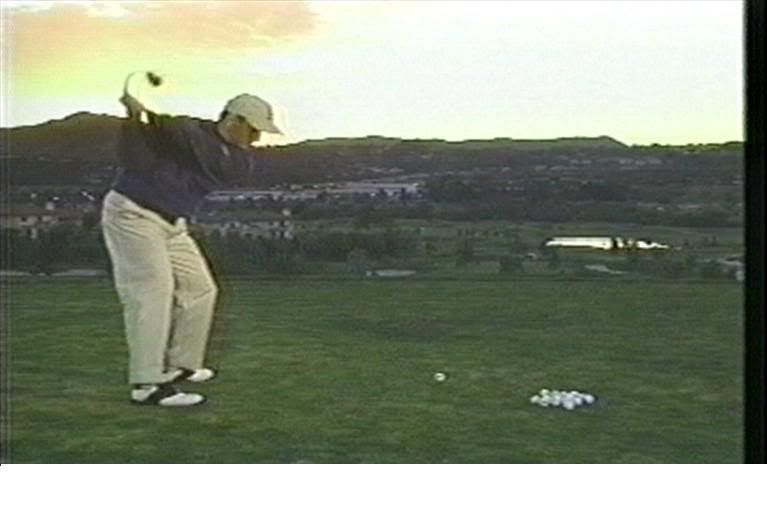
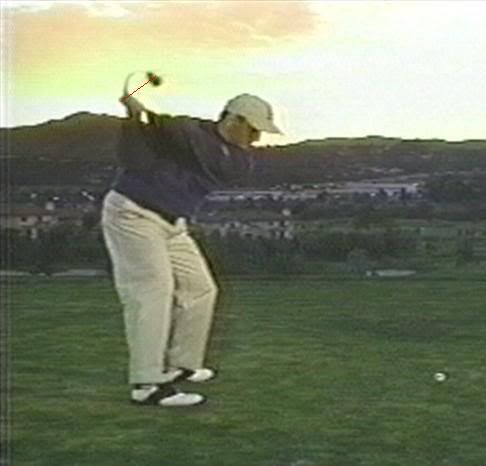
People say Sergio has lots of Lag. That's Accumulator #2 Lag they are usually referring to. The angle between left arm and clubshaft is what they see.
But TGMers know that Clubhead Lag is the resistance of the Sweetspot to change direction, which is established during Start Down. It is very slight, very ellusive and hard to see.
But it's not hard to see in this case!
Now THAT'S Clubhead Lag!
You may say he's using some women's whippy shaft. Uhh....no. It's XXX
Now someone draw a straight line from the #3PP to the CG of the Clubhead...then you'll really capture it!!!!
People say Sergio has lots of Lag. That's Accumulator #2 Lag they are usually referring to. The angle between left arm and clubshaft is what they see.
But TGMers know that Clubhead Lag is the resistance of the Sweetspot to change direction, which is established during Start Down. It is very slight, very ellusive and hard to see.
But it's not hard to see in this case!
Now THAT'S Clubhead Lag!
You may say he's using some women's whippy shaft. Uhh....no. It's XXX
Now someone draw a straight line from the #3PP to the CG of the Clubhead...then you'll really capture it!!!!
In his book (How I play golf, Golf Digest editions) Tiger explain that they have had to use a special camera (65 frames per second) .
So, these are not screen shots and it seems that the shaft is bendind
Anyway, we are not on a photography site. But Clubead Lag is the "Secret of golf" , and sometimes pictures may be a good complement to assimilate knowledge.
Hijacking my own thread, but check out that tripod, or lack thereof. His head is over his right foot (as opposed to the middle, according to the tripod concept)! The camera angle can make things look worse, but...
__________________
tongzilla
Last edited by tongzilla : 01-12-2006 at 06:36 PM.
By the way Golfie, I really appreciate your contributions.
Can you please give references in the book regarding your statement above?
Thanks
Leo,
While I do not know the book backwards and forwards. I would suggest 6-C-2-C as the paragraph you seek. Am I wrong to assume that Homer wishes to deliver a clubshaft that is stressed backward?
Also I recall from some other site Homer's experiment where he put a mass (an ounce I think) and realized a bend of of a 1/8th (again fuzzy) of an inch. (Someone please help with the exct details if is is important!) From this he concluded that every 1/8 of an inch of clubhead lag (shaft lag) was as good as adding an ounce to the head of the club.
BTW I don't think this discussion would help anyone's game. I just didn't want anyone to get excited about the massive toe-up "observed" bend from the original pic. Attempting to achieve such a thing would damage more than a few wrists.
Golfie
__________________
Swinging and loving it
Last edited by Golfie McG : 01-12-2006 at 06:42 PM.
Hijacking my own thread, but check out that tripod, or lack thereof. His head is over his right foot (as opposed to the middle, according to the tripod concept)! The camera angle can make things look worse, but...
So, assuming the camera angle doesn't lie -- a heroic assumption (see below) -- and assuming Tiger doesn't Sway, the Low Point of the Stroke (ideally, opposite the Left Shoulder) is going to occur a bit forward of the middle of his Stance (and not over his left foot as is the normal case). Does phimaynard have an Impact photo in this sequence? If so, could we also see the Ball Location?
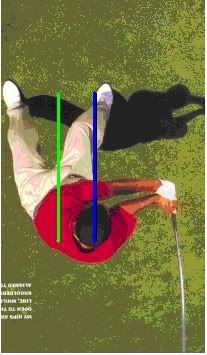
At this point in the Stroke, El Tigre appears to be leaning backwards -- his right ear is outside his right foot -- in an attempt to hit 'up' through Impact. This could well be the case if his intention was to minimize the Compression Leakage of Backspin (and its quid pro quo...[b]control). On the other hand, at the same point in the Stroke, the back view photo (below) in phimaynard's original post shows the right ear to be just in front of his right knee and well inside the Stance.
BTW, another way to hit 'up' is to respect the geometry of the Stroke by locating the Head in the center of the Stance through Impact and the Ball forward of Low Point.
In his book (How I play golf, Golf Digest editions) Tiger explain that they have had to use a special camera (65 frames per second) .
So, these are not screen shots and it seems that the shaft is bendind
Anyway, we are not on a photography site. But Clubead Lag is the "Secret of golf" , and sometimes pictures may be a good complement to assimilate knowledge.
Thanks for the pics, now that's a more reasonable amount of clubshaft lag. Though it's really not frames/sec that causes distortion - it's shutter speed (how long the shutter is open).
Do you think that the direction in bend that Tigers picture show will be useful per 6-C-2-C given that the clubshaft will rotate 90 degrees before imnpact
While I do not know the book backwards and forwards. I would suggest 6-C-2-C as the paragraph you seek. Am I wrong to assume that Homer wishes to deliver a clubshaft that is stressed backward?
2-M-1 last sentence or two adds to the description.
Interesting is that the deflection of the clubshaft in the pictures shown is in fact the opposite (for the most part) that of the direction of clubhead droop.
Backwards would be the deflection at impact that is desired. It was once or maybe still is stated that this backward deflection would be timed to release at impact, adding to the ball's velocity. This is not an accurate concept for practical application nor is it what Homer has suggested.
Tongzilla intial post has really left eveyone hanging. How does the flexing, stressing the clubshaft in the direction shown in the picture (effectively bending the shaft so the toe would move upward) while PP#3 is on the aft of the shaft, 90* out of line with this movement?
I would respectifully submit that the clubshaft stress in these pictures are not 'clubhead lag' and this is something that is more common for a swinger than a hitter to experience.
Also I believe on reason Homer suggested using the stiffest shaft possible was to over come this phenomenon, which can lead to inconsistencies.
I should add..
This phenomenon that is shown is the change is direction at the top or end of the swing to the start down. The acceleration would be proportional to the shaft flex and force applied. The longer into the downstroke the acceleration continues to increase the more the shaft will be stressed. As the acceleration levels off the prestress will decrease.






 This could well be the case if his intention was to minimize the Compression Leakage of Backspin (and its quid pro quo...[b]control). On the other hand, at the same point in the Stroke, the back view photo (below) in phimaynard's original post shows the right ear to be just in front of his right knee and well inside the Stance.


 Linear Mode


