One last point, when addressing the golf ball, the club should not be grounded if you are aligning the golf ball with the sweet spot. It should hover. If you were to ground it, you then need to ensure that as the club goes to the ground, the ball moves out toward the toe and the toe should be raised off the ground with the heel just touching. Anything else will require compensations in the golf stroke to get the club back to the proper Impact Fix position.[/quote]
Trolling around per usual and stumbled on this post. I am aware of how to sole the club correctly with regards to the ball being addressed towards the toe, but I did not know about the toe sticking up in the air. Can anyone enlighten me? Is that in 2-J-3?
[/quote]Trolling around per usual and stumbled on this post. I am aware of how to sole the club correctly with regards to the ball being addressed towards the toe, but I did not know about the toe sticking up in the air. Can anyone enlighten me? Is that in 2-J-3?[/quote]
This point has always confused me. I find it easy to hover the driver, not irons. Homer says:
"A geometrically proper procedure is to establish the correct radius with the Clubhead rasied to the desired Impact realtionship. Then maintain the center of the arc-that is, the left shoulder-as now established, and hold the Hands at the height and angle now established, then let the club swing down from the Wrist to rest on the ground. Now apply Extensor Action (6-B-1-D) to stretch the left arm and 'get as 'far away from the ball as possible.' (Without disturbing any of the Fix alignments) So- 'Soled,' the ball is toward the Toe of the Clubface, but 'on center' for Impact. All this is the geometry for a clean pick-off.
2-J-1.
It seems to me that by letting the club swing down from the Wrist, the left wrist goes from level to uncocked and that the toe, correspondingly, gets lowered, not raised.
Now I am not at all sure about this and I have never heard of any teachers or even players talk about this. But, on those rare days that my irons can do no wrong, I find something along this line to be instictively correct.
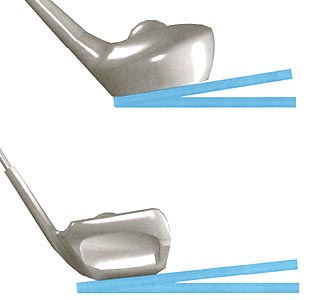
I believe that most golfers have their hands higher at impact with a slightly steeper clubshaft angle than at address. Therefore, the correct lie is established at impact, and not at address. At address, the toe of the club should be elevated slightly off the ground if the lie is correct - see next photo.
Note that the toe of the club is off the ground for both woods and irons.
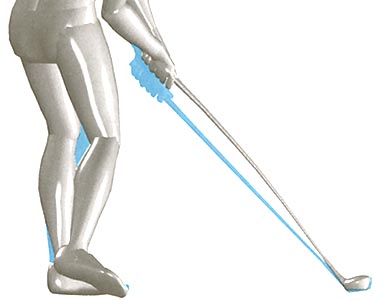
At impact, this next diagram shows the likely hand and clubshaft position.
Blue color = Address position. Grey color = impact position.
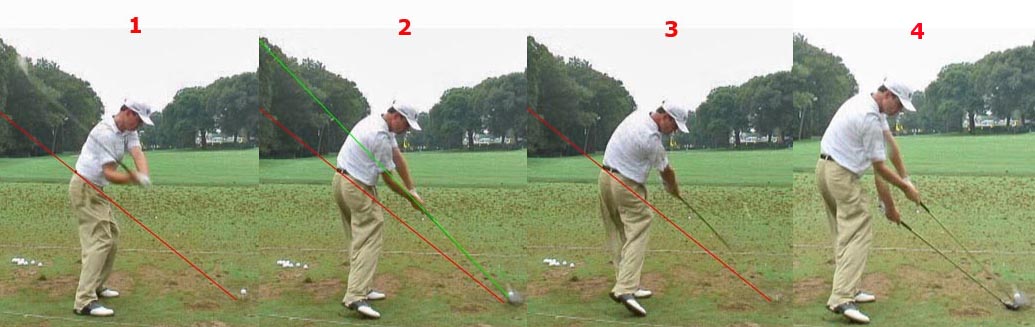
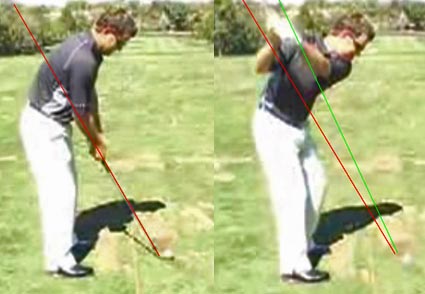
The degree that the hands are higher at impact varies between different players. Hogan got to the same low hand position, but Zach Johnson's hands are much higher at impact than address - see next photo.
The red line is the hand plane at address. Image 4 shows the difference in hand position between address and impact.
Homer offers this piece of advice to establish the swing radius.
""A geometrically proper procedure is to establish the correct radius with the Clubhead raised to the desired Impact relationship. Then maintain the center of the arc-that is, the left shoulder-as now established, and hold the Hands at the height and angle now established, then let the club swing down from the Wrist to rest on the ground. Now apply Extensor Action (6-B-1-D) to stretch the left arm and 'get as 'far away from the ball as possible."
I personally don't think that it can be very critical to pre-establish this swing radius at address, because the true swing radius at impact is very different (as demonstrated in the Zach Johnson photo) and the left shoulder socket is not in the same position at impact as it is at address.
Just saw your reply. Thank you for explanation as well as the pics, Jeff. I really appreciate the visuals you have provided. Althought, it gets testy at times I also appreciate the thinker threads you have initiated. Is this still the case if your intention is a zero shift, using the turned shoulder plane?
I think that this difference between impact and address hand/clubshaft alignments gets markedly minimized (or eliminated) if one uses a zero-plane shift swing with a steep clubshaft plane (eg. on turned shoulder plane).
I have never seen a swing video of a golfer who has a zero-plane shift swing on the turned shoulder plane. The only zero-plane shift swing I have seen is Moe Norman's swing.
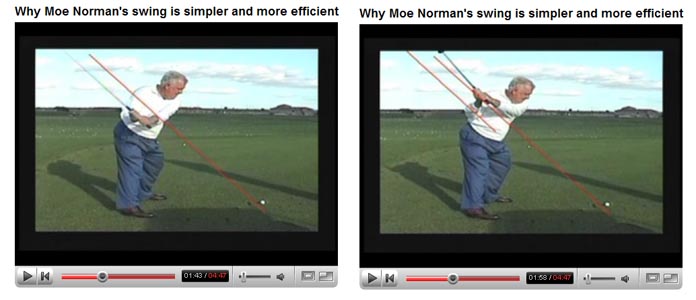
You can see that More stretches his arms out at address and his clubshaft-at-address plane is higher than the hand plane. The photo-series shows only the backswing and he stays on a single plane during the entire backswing. During the downswing, he comes down that same plane and he ends up on the clubshaft-at-address plane at impact.
Brian Gay also has close to a zero-plane shift swing.
Brian Gay also holds his hands high at address, and doesn't have much plane shift during the backswing (his hands end up just under the turned shoulder plane at the end-backswing). He then comes down to the same clubshaft-at-address plane (elbow plane) at impact.
I was thinking along those lines! I have been working hard on emulating 10-6-B#1 at address and # 2 at top with mixed success. My hands are used to starting low and then finding their way to a more upright plane at impact. I find the distinction between address and impact helpful. Still, shifts are hazardous! Thanks again for your insights.
One month ago, you wrote on another forum, in a very controversial thread about plane shift:
20/05/2008
This issue of More having a zero shift swing has previously been discussed, and I produced a number of images that demonstrates that Moe has a single (not zero) plane shift swing
Jeff
Today you say:
Originally Posted by Jeff
I have never seen a swing video of a golfer who has a zero-plane shift swing on the turned shoulder plane. The only zero-plane shift swing I have seen is Moe Norman's swing.
Jeff.
I admit to be a little disorientated
Can you indicate where is the truth and why you changed opinion?
I had to change my mind because I was proven wrong. I originally took the position that Moe Norman shifted planes during the backswing - based on an analysis of this swing video.
This is a photo series form that swing video.
It looks like Moe Norman is on shallower, but parallel, plane in mid-backswing. However, I now realize that my interpretation of a plane shift was wrong and that it was due to camera angle distortion-error. I only realized that Moe Norman really stayed on the same plane when I had the opportunity to analyse a swing video from an up-the-line (rather than down-the-line) swing video where there was far less camera angle parallax error problems. I then realized that Moe Norman really had a zero-plane shift swing.
As a Popperian, I was forced to change my opinion when my original opinion was falsified by "solid" contrary evidence. Later in that forum's thread, I admitted I was wrong and I produced this photo-series showing how Moe Norman's clubshaft stayed on the same plane during the backswing and downswing.






 Linear Mode


